What is drain jetting and how does it work? Drain jetting, or hydro jetting, uses a high pressure stream of water to clean pipe walls, removing grease, scale, root tendrils, and buildup that a standard snake can’t touch. Think of it like a pressure washer, but for your pipes. Our post on hydro jetting covers when we jet a line and when a cable is the better tool. This one walks through what actually happens when we come out to jet a drain, so you know what to expect.
Before We Get There
When you call, tell us which drains are slow, whether water is coming up in a tub, shower, or floor drain, and how many times the line has been cleaned before. If your main line gets cabled once or twice a year, that isn’t bad luck, that’s a pipe telling you something, and it helps us to know that going in.
If you know where your cleanout is, clear a path to it. It’s usually a capped pipe sticking up out of the ground near the foundation. If water is backing up, stop running water in the house until we arrive, because everything you send down comes back up somewhere.
How a Jetting Visit Goes, Step by Step
Step 1: Find the blockage and how bad it is
These jobs always start with a diagnostic visit so we can give you an honest assessment before any work begins. We find where the line is blocked and how bad it is, then go over your options and let you choose.
Step 2: Get into the line at the cleanout
The jetter goes into the line through a cleanout, a capped opening built into the drain for this kind of work. If there isn’t one, or the one you have is buried or broken, adding a cleanout becomes its own line on the estimate, written up and priced before we do the work.
Step 3: Open the line, then look
If the house is backed up, we open the line first. A camera can’t see through a stoppage, so the line gets cleared first, and then we look. Cable when the house is backed up tonight, jet when a line still runs slow after being cabled over and over.
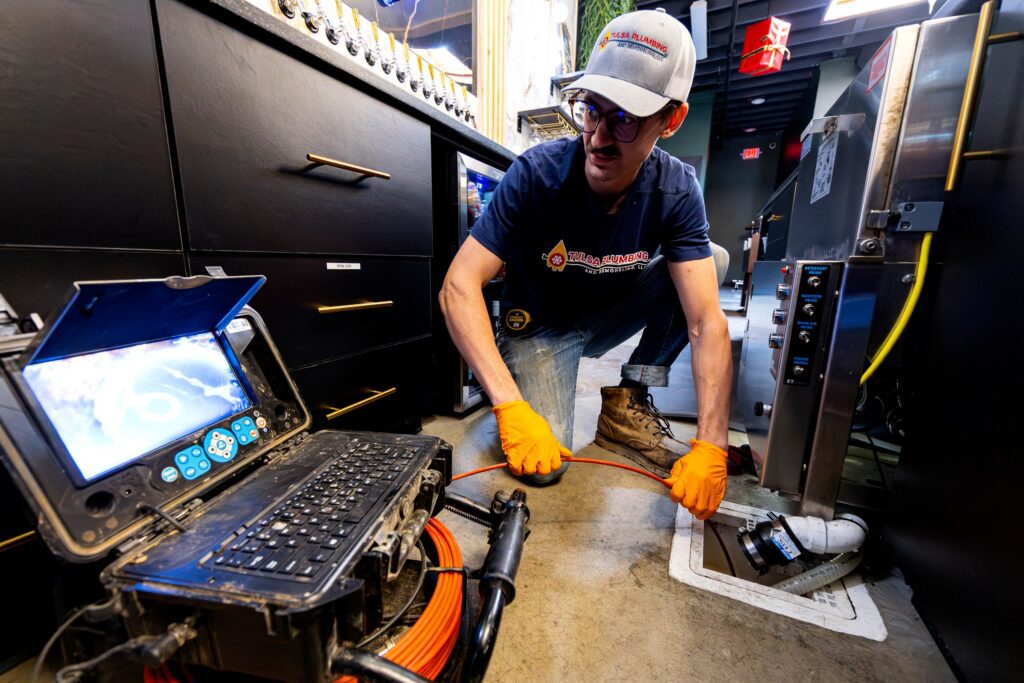
On old clay or thin cast iron, we want camera footage before we jet. The camera shows roots at a joint, a crack, an offset, or scale inside cast iron, and that tells us whether the pipe is a good candidate for the jetter. It shows what’s actually wrong, which is the difference between a repair and a guess.
Step 4: Run the jetter
The jetter pushes water at high pressure through a hose with a nozzle on the end. The nozzle sprays forward to break up what’s in front of it and backward to pull itself down the line, so it scours the pipe wall as it goes and flushes what it loosens downstream. Grease, scale, and root tendrils come off the wall instead of staying behind for the next clog to catch on.
Step 5: Confirm it’s flowing
We run water and verify full flow is restored before we pack up. You’ll know it’s fixed.
If the Camera Finds Damage
Jetting cleans a pipe, it doesn’t put one back together. If the camera shows a broken section, roots at every clay joint, or cast iron channeled end to end, the conversation turns to a repair, and our sewer and slab services page covers what that looks like. Either way, we’ll tell you what we found before anything else gets done.
What It Costs
On our published price list, hydro jetting a main sewer line runs $400 to $800, and a camera inspection of the sewer line runs $200 to $400. Where yours lands depends on the access, the length of the line, and what’s in it, and you get the price before we start.
Ready to Have a Line Looked At?
If your main line keeps backing up after it’s been cabled, or every drain in the house is slow, call Tulsa Plumbing & Remodeling at (918) 800-4426. Most drain calls are same-day. For everyday clogs, our post on the clogged drain fix covers what to try yourself first.