
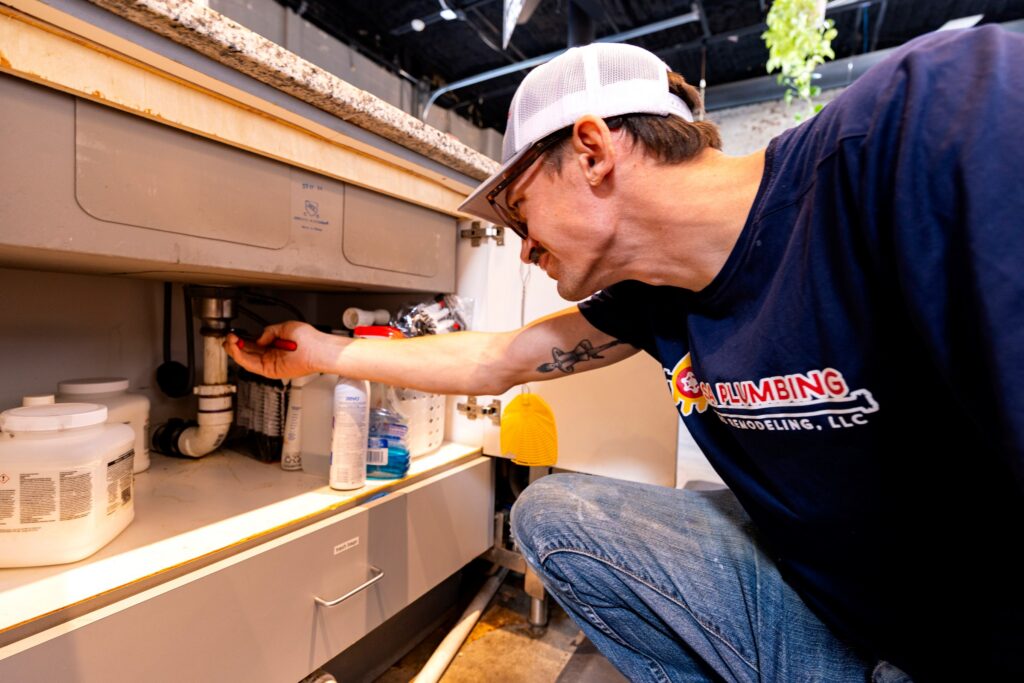
Slow drains are one of the most common calls we get, and most of them start the same way: a sink that drains a little slower every week until it stops. A clogged drain fix doesn’t always need us. Our honest guidance: if one drain is slow and you’ve got a basic plunger, give it a try. That’s a fair first step. Here’s how to do it right, how to clean the trap under a sink, how far a hand auger can take you, and the signs that it’s time to put the tools down and call.
Find Out What’s Clogged First
The fixture that’s backing up tells you most of what you need to know.
Kitchen sinks
Grease, food scraps, and soap residue are the usual suspects. Grease goes down warm and liquid, then cools and coats the inside of the pipe, and food catches on it.
Bathroom sinks, showers, and tubs
Hair, soap scum, and toothpaste build up fast. A bathroom clog is usually close to the drain opening, in the stopper or the trap, which puts it within reach.
Toilets
Toilets usually clog on things that don’t break down the way toilet paper does: wipes, including the ones labeled flushable, paper towels, and cotton swabs.
More than one drain at once
If several drains are slow or backing up at the same time, or water comes up in the tub when you flush, that isn’t a fixture clog. The blockage is out in your main line, and no plunger is going to reach it. Stop running water in the house, because everything you send down comes back up somewhere, and see our post on drain cleaning in Tulsa for what to do while you wait for us.
Plunge It the Right Way
Most plunging fails for one reason: the pressure escapes somewhere else. Before you start, plug the overflow hole on a bathroom sink with a wet rag, and on a double kitchen sink, cover the other drain. That way the push goes into the clog instead of out the overflow.
Use a flat cup plunger on sinks, tubs, and showers. A toilet takes a flange plunger, the kind with the extra rubber sleeve that fits into the bowl’s outlet. Leave enough water in the fixture to cover the cup, press down gently to push the air out, then pump firmly while keeping the seal. Pull it away, see if the water moves, and repeat a few times.
Every toilet has its own stop valve behind it. Close it before you plunge so a flush that doesn’t go down can’t overflow the bowl.
Clean the Trap Under the Sink
The trap is the curved pipe under the sink. It holds water to keep sewer gas out of the house, and it’s also where hair, grease, and anything dropped down the drain tends to stop.
Set a bucket under it and lay a towel down. Loosen the two slip nuts, by hand on plastic or with channel lock pliers on metal, and lower the trap into the bucket, because it’s full of water. Clean it out, rinse it, and put it back with the washers seated. Snug the nuts by hand plus a little more, because over-tightening cracks plastic. Run water and check both joints for drips.
If the trap was clean and the sink still won’t drain, the clog is past the trap, in the pipe going into the wall.
A Hand Auger for Clogs Past the Trap
A hand auger is a cable on a crank. With the trap off, feed the cable into the pipe in the wall until you feel resistance, then turn the handle while you push gently. Work it back and forth in short strokes, and keep turning as you pull it out so the cable brings the clog with it instead of packing it farther down. Put the trap back and run water slowly.
A toilet takes a toilet auger, which has a sleeve that protects the porcelain.
When to Put the Tools Down
Stop and call us when you run into any of these.
The cable hits a hard stop
A soft, spongy feel is usually grease or hair. A hard stop that the cable won’t get past can be roots, a broken or offset pipe, or something solid, and forcing it can get the cable stuck in the line. That’s a job for a camera. It shows what’s actually wrong, which is the difference between a repair and a guess.
Water comes up somewhere else while you work
If water rises in a tub or another drain while you’re plunging or running the cable, the clog is in a line those fixtures share, and the problem is bigger than one sink.
It’s the third time in a few months
If the clog doesn’t clear quickly, if you’re seeing it in more than one drain, or if this is the third time it’s happened in a few months, that’s when to call us. Recurring clogs usually mean something deeper is going on. If your main line gets cabled once or twice a year, that isn’t bad luck, that’s a pipe telling you something.
Skip the Chemical Drain Openers
We’d skip the bottle of drain opener. On a drain that’s fully stopped, it often doesn’t clear the clog, and then it’s sitting in the pipe when someone has to take it apart. If you’ve already poured one in, tell us when you call so we know before we open the line.
What We Do When You Call
Every drain call follows the same three steps. We find where the clog is and how bad it is, then go over your options and let you choose. We clear it with the right tool for the job, from a drain snake to a hydro jetter. Then we run water and verify full flow is restored before we pack up.
On our published price list, clearing a single kitchen sink, tub, or floor drain clog runs $125 to $275, and you get the price before we start. When a line keeps coming back, our post on hydro jetting covers when we jet a line and when a cable is the better tool.
Still Stopped Up?
Most drain calls are same-day. When you call, tell us which drains are slow and whether water is coming up anywhere else. That tells us whether it’s one fixture or the main line before we pull up. Call Tulsa Plumbing & Remodeling at (918) 800-4426, or schedule online from our drain cleaning page.