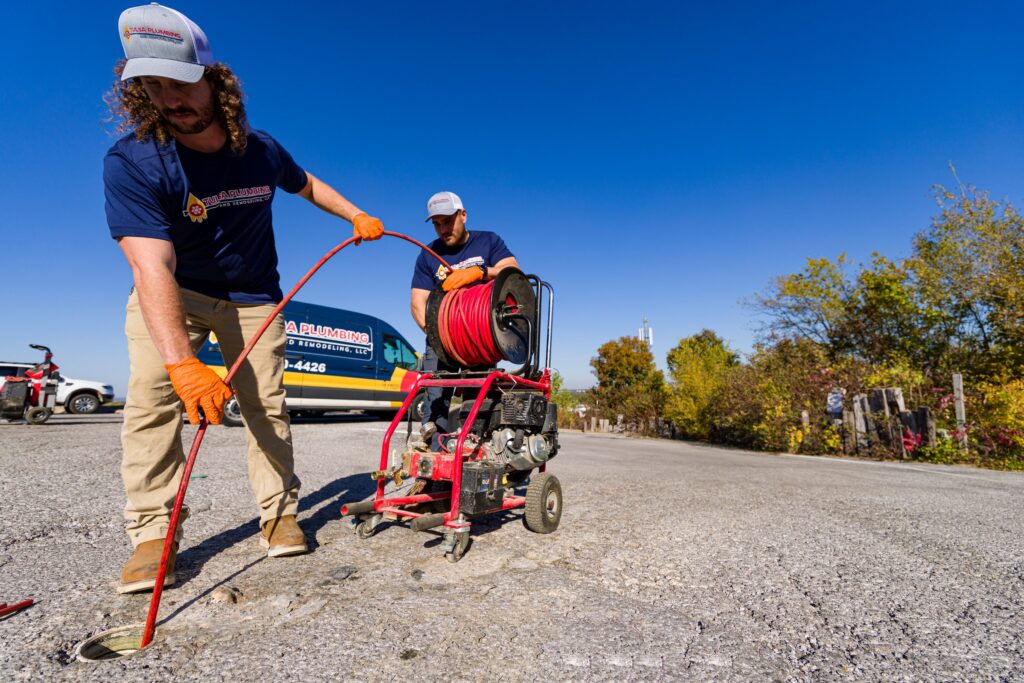
Hydro jetting uses a high pressure stream of water to clean pipe walls, removing grease, scale, root tendrils, and buildup that a standard snake can’t touch. Think of it like a pressure washer, but for your pipes. It isn’t the answer to every clog, though, and on the wrong pipe it’s the wrong tool. Here are the questions we get most about jetting a drain, answered the way we’d answer them on the phone.
How Hydro Jetting Works
What is hydro jetting?
A jetter pushes water at high pressure through a hose with a nozzle on the end. The nozzle sprays forward to break up what’s in front of it and sprays backward to pull itself down the line, so it scours the pipe wall as it goes and flushes what it loosens downstream.
How is that different from running a cable?
A cable cuts through the blockage. A jetter uses high pressure water to scour the pipe wall. The cable opens a path and gets you flowing, but grease and scale stay on the pipe wall, and that’s where the next clog starts.
When We Jet and When We Don’t
When do you use a cable, and when do you jet?
Cable when the house is backed up tonight, jet when a line still runs slow after being cabled over and over. If your main line gets cabled once or twice a year, that isn’t bad luck, that’s a pipe telling you something, and a camera tells you what.
What does jetting handle best?
Recurring clogs that keep coming back, slow drains throughout the entire home, and main line maintenance so you’re never surprised by a backup. It’s especially effective on grease-heavy lines in restaurants and commercial kitchens.
Why do you want a camera in the line first?
On old clay or thin cast iron, we want camera footage before we jet. The camera shows roots at a joint, a crack, an offset, or scale inside cast iron, and that tells us whether the pipe is a good candidate for the jetter. A camera can’t see through a stoppage, so a backed up line gets opened with a cable first, then we look.
What Jetting Can’t Fix
Will jetting get rid of my roots for good?
No. Jetting washes out root tendrils, and we cut heavier roots with a cable machine. Either way that gets you flowing today, but it does nothing about the crack they came through, so they’ll be back. Pay to have them cut two or three times a year and you’ve already spent the repair money, you just don’t have the repair.
Can jetting fix a belly in my line?
No. A belly is a low spot where the pipe lost its fall, so waste sits in it. Around here that’s Tulsa clay moving with the wet and dry cycles. Jetting clears what’s sitting in it for a while, but you can’t clean a belly out or line it away, because the grade failed, not the pipe. The fix is to re-bed that section at the right fall.
What if the camera finds broken pipe or Orangeburg?
Then it’s a repair conversation, not a cleaning one. Jetting cleans a pipe, it doesn’t put one back together. Orangeburg, a tar paper pipe found in some Tulsa houses from the mid 1940s to the early 1970s, has a short lifespan. One failed section is a spot repair. Clay with roots at every joint, or cast iron channeled end to end, and a spot repair moves the next failure ten feet down the pipe. Our sewer and slab services page covers sewer repair.
Jetting for Restaurants and Commercial Kitchens
Does a restaurant need its lines jetted?
Grease-heavy kitchen lines are where jetting earns its keep. Grease coats the pipe wall a little at a time, and a cable only opens a path through it. Jetting the main line on a schedule, as preventive maintenance, keeps you from being surprised by a backup. Our commercial plumbing page covers the rest of what we do for businesses.
Cost and What to Expect
How much does hydro jetting cost?
On our published price list, hydro jetting a main sewer line runs $400 to $800, and a camera inspection of the sewer line runs $200 to $400. Where yours lands depends on the access, the length of the line, and what’s in it, and you get the price before we start.
What happens on the visit?
We find where the line is blocked and how bad it is, then go over your options and let you choose. If the jetter is the right tool, we run it through the line, then run water and verify full flow is restored before we pack up.
Not Sure Whether Your Line Needs a Jetter?
If your main line keeps backing up after it’s been cabled, or every drain in the house is slow, call Tulsa Plumbing & Remodeling at (918) 800-4426. We’ll tell you whether it needs a cable, a jetter, or a camera first, and you’ll have the price before we start. We offer same-day service when the schedule allows.
For everyday clogs and what’s worth trying yourself first, see our post on drain cleaning in Tulsa.