
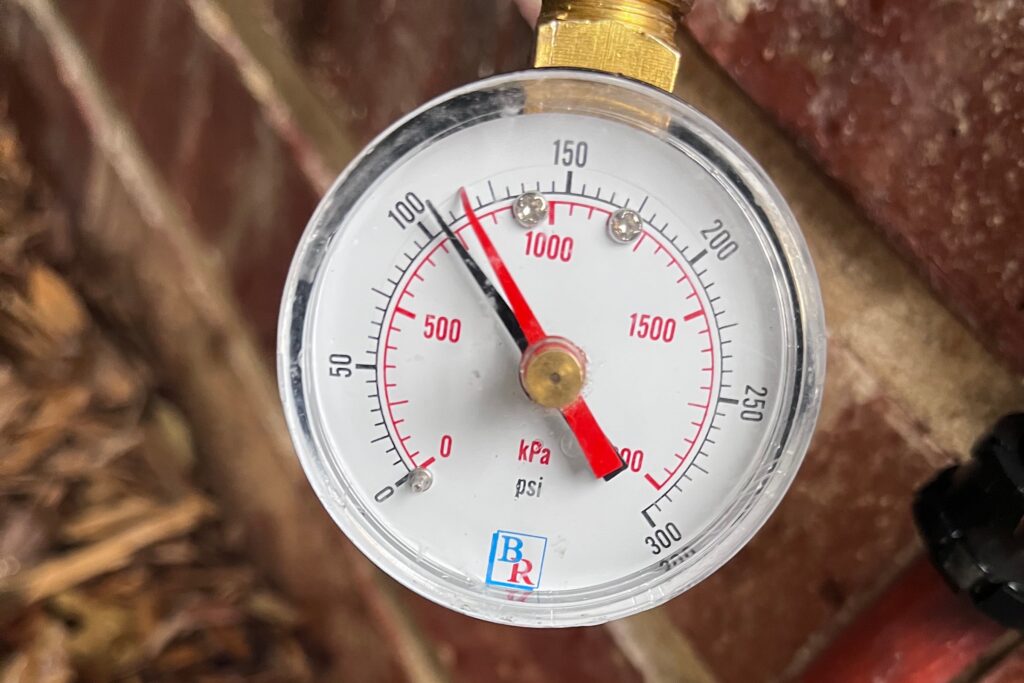
Water pressure problems come in two kinds. Too low, and you notice it every time you turn on the shower. Too high can feel like a good thing, but it shortens the life of your faucets, supply lines, water heater and toilet parts. Here’s how we tell which one you have, and what usually fixes it.
How We Check Your Water Pressure
We put a gauge on a hose bib and read it. Anything over 80 psi is above code.
When the complaint is low pressure, the first thing we sort out is whether it’s the whole house or one fixture, because the causes are different.
Signs Your Water Pressure Is Too High
Banging pipes are one sign. A water heater relief valve that keeps dripping is another. The temperature and pressure relief valve, the T and P, opens past about 150 psi or 210 degrees and dumps the water at the floor. A steady drip means high pressure, a waterlogged expansion tank, or a thermostat set too hot. Never cap that pipe.
Even without those signs, high pressure shortens the life of your faucets, supply lines, water heater and toilet parts.
The Usual Fix: a Pressure Reducing Valve
The fix is usually a pressure reducing valve on your main, also called a PRV or a pressure regulator. PRVs last 10 to 15 years and fail in either direction, too much pressure or not enough, so an old one can be behind either problem.
Sometimes the valve only needs adjusting. On our published price list, a water pressure regulator adjustment runs $275 to $525. When the valve needs replacing, we price it before we start work, so there aren’t any surprises when you get the bill.
Why a PRV Means You Need an Expansion Tank
A pressure reducing valve or a check valve on your main makes a closed system, and heated water has nowhere to expand. Without an expansion tank, you get a dripping T and P valve and banging pipes.
If you already have an expansion tank, the bladder inside it gives up around 5 to 10 years, so we check it on every water heater visit. An expansion tank replacement runs $350 to $675 on our price list.
Older Tulsa homes hit the same things on inspection reports, and a water heater with no expansion tank is one of them. Our post on a leaking water heater covers the relief valve and what to do if there’s water on the floor.
Low Water Pressure: One Fixture or the Whole House?
Just one faucet
One faucet is usually a clogged aerator, a partly closed valve, or a worn cartridge. Tulsa’s hard water packs those aerator screens with scale, so rinse it out first. That’s a five-minute fix.
If it’s the cartridge, a faucet cartridge replacement runs $150 to $300 on our price list. That’s a normal day for us. And if you describe it and it turns out to be something you can handle yourself, we’ll tell you that instead of driving out there.
The whole house
Whole house is a failing PRV, a softener stuck in bypass, a main line leak, or galvanized pipe silted shut. If the pressure dropped all over the house at once, start with your water meter.
Check Your Meter for a Main Line Leak
Your water meter will tell you about a hidden leak before your eyes will. Shut off every faucet, the ice maker, and the irrigation, then watch the small triangle on the meter. If it’s still moving, water is going somewhere.
A running toilet keeps your meter moving just like a hidden leak would, so check the toilets. If they check out and the meter is still moving, close your main shutoff at the house and watch the meter again. If it keeps moving with the main closed, the leak is outside, on the buried line between the meter and your house.
In most Tulsa homes the main shutoff is near the front hose bib, in the garage, or in a utility closet. Round handle, turn it clockwise until it stops. Straight lever, a quarter turn so it sits crossways to the pipe. If it won’t turn with normal hand pressure, don’t force it, call us.
You own the water line from the outlet side of the meter to the house. A pinhole in that buried line shows up as a soft patch of yard that stays wet, or one strip of grass thriving through an August dry spell. Our post on water leak detection walks through how we find it from there.
Galvanized Pipe Closes Down From the Inside
In galvanized pipe, the rust builds up as scale along the inside of the pipe, so a line that started at three-quarter inch slowly closes down. Every fixture runs weaker, and cleaning aerators won’t fix it, because the restriction is inside the pipe itself.
One tell is a hot side noticeably weaker than the cold, because the hot lines scale up first. Galvanized steel can easily last 60 to 70 years, and a lot of Tulsa’s older neighborhoods are past that now. If you’re seeing leaks, flakes in your water, or low pressure, it’s time to repipe.
Not sure what your pipes are made of? Our post on how to tell if your house needs repiping shows where to look.
Need Your Water Pressure Checked?
Call us at (918) 800-4426. Tell us whether it’s one fixture or the whole house, and whether you’ve noticed banging pipes or a dripping relief valve on the water heater.
We give you the price before we start. If we open a wall and find something nobody could have seen from the outside, we stop, re-price it with you, and you’re the one who says go. Our general plumbing page covers the rest of the small jobs we handle.