
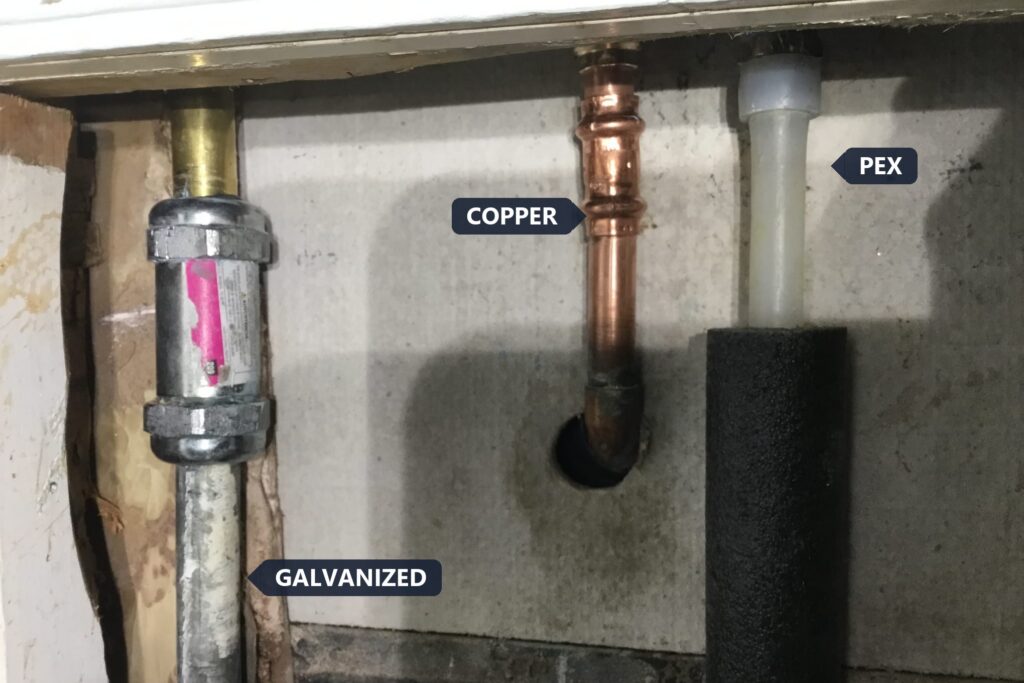
How do I know if my house needs repiping? Start with what your pipes are made of. The material tells you more than any one symptom, and you can usually find out in a few minutes with a flashlight and a refrigerator magnet. Then match what you found with what the house is doing, and the answer gets a lot clearer.
We already covered the warning signs that point to a repipe. This is the step before that: walking your own house, finding the pipe, and knowing what you’re looking at.
Where to Find Your Water Supply Pipes
You’re looking for the supply lines, the ones under pressure that feed your faucets, not the drains. A full repipe replaces your home’s supply lines, so those are the pipes that answer the question.
At the water heater
The two lines on top of the water heater are the cold coming in and the hot going out. Follow them a foot or two past the connectors, because the connectors get replaced along with the heater and are often newer than the rest of the house. On a gas water heater, the pipe running into the control valve near the bottom is the gas line. It’s usually black steel, it’s threaded, and a magnet sticks to it, so don’t let it fool you into thinking you have galvanized water pipe.
At the main shutoff
The main shutoff is usually where the line enters the house, in a garage, utility closet, or outside wall. Look at the pipe on the house side of that valve. The pipe coming in from the meter is the service line, and it can be a different material than the rest of the house.
Under the sinks, in the crawlspace, and in the attic
Under a sink, look past the shutoff valve to the pipe coming out of the wall. If you have a crawlspace, that’s the best look in the house, because you can see the runs themselves. On a slab house, the lines run under the concrete, through the attic, or both, so the water heater and the sinks are your easiest looks.
Check more than one spot. Plenty of older houses are a patchwork, with copper or PEX wherever somebody fixed a leak or remodeled a bathroom and the original galvanized everywhere else. Where copper connects to galvanized, look closely at that joint. Two different metals touching corrode each other, and that’s a common place for a leak.
Three Quick Tests to Tell Your Pipes Apart
The magnet test
Hold a refrigerator magnet against the pipe. A magnet sticks to galvanized steel. It won’t stick to copper, brass, or any of the plastics. If a gray metal pipe won’t hold a magnet, it isn’t galvanized, so call us and we’ll identify it.
Look at the joints
Galvanized screws together, so you’ll see threads and bulky fittings at every turn, often with rust crusted around them. Copper is soldered, with smooth fittings and a thin silver ring where the solder flowed. PEX joins at brass or plastic fittings, usually with a ring around the tubing. CPVC is glued, with smooth plastic sockets at each joint.
Scratch it and read it
If the pipe is painted or dirty, scrape a small spot with a coin or a key. Galvanized shows dull silver gray. Copper shows the color of a new penny. Plastic pipe is easier, because it’s usually printed along its length with what it is, so wipe it off and read it.
What Your Pipe Material Tells You
Galvanized steel: gray, threaded, and magnetic
Galvanized steel can easily last 60 to 70 years, and a lot of Tulsa’s older neighborhoods are past that now. Original pipe in a house built in the 1950s is right there. If you’re seeing leaks, flakes in your water, or low pressure, it’s time to repipe.
One tell you can check at the kitchen sink: open the hot all the way, then the cold. A hot side noticeably weaker than the cold is a sign of galvanized trouble, because the hot lines scale up first. If galvanized is what you found, our post on galvanized pipe replacement walks through what comes next.
Copper: reddish brown, soldered, and not magnetic
Copper corrodes from the inside out, so a pinhole says more about the run than the spot. Aggressive water, undersized pipe, flux left sitting in the line, and thin wall type M instead of type L all push it along. The first pinhole is a repair. The second in the same house means the whole run. If you can still read the printing on the copper, red lettering means type M, the thin wall, and blue means type L.
PEX: flexible red, blue, or white tubing
PEX is what we install on a repipe, so a house that’s PEX throughout has either been repiped already or was built with it. Pex is our default because it bends, so we pull it through the attic and down the walls with far fewer holes cut than copper takes. If your house is already PEX, the usual rule holds: one leak is a repair.
CPVC: rigid cream or tan plastic
CPVC is rigid plastic, usually cream or tan, glued at the joints. It won’t rust or scale up like galvanized. Older CPVC can turn brittle, so don’t twist it or lean on it while you’re looking. Like copper, its age and its leak history decide it.
Polybutylene: gray plastic, often stamped PB2110
Flexible gray plastic, sometimes blue or black, often stamped PB2110, is polybutylene. It went into a lot of houses built from the late 1970s to the mid 1990s, and it has a long record of leaks. Our leak repair and repiping page lists it right next to old galvanized. If you find it, call us and we’ll look at what you have.
Put the Pipe Together With What the House Is Doing
The material is half the answer. The other half is what the pipe is doing. One leak is a repair. Leaks in different parts of the house inside the same year is a repipe. In between, it comes down to the material, the age, and how close together the leaks came.
Two checks help with that half. Your water meter will tell you before your eyes will: shut off every faucet, the ice maker, and the irrigation, then watch the small triangle on the meter. If it’s still moving, water is going somewhere. And fill a clear glass from the cold tap first thing in the morning at a couple of faucets. Rust in the cold water can’t come from the water heater, so if it shows up at more than one faucet and your neighbors don’t have it, it’s coming from your pipe.
What We Check When You Call
When we look at a leak, we look at the full picture: the repair in front of us and what the rest of the pipe looks like. We isolate and pressure test sections ourselves and run acoustic gear that hears water under concrete. Then we tell you which one you’re looking at, a repair or a repipe, even when it’s the cheaper one.
If it is a repipe, Pex is our default and we’ll run copper if you want it. It typically takes 1 to 3 days, and you can stay in the house. The water is off while we work, but we turn it back on before we leave every evening. We pull the plumbing permit ourselves, our labor carries a one year warranty, and you get a written price before anything starts. Drywall and paint aren’t our trade, so we keep the cuts small and tell you where they’re going.
Repiping an entire house ranges from $5,000 to $7,000 on average, with high-end estimates at $15,000 or more for large, difficult homes. Our repipe cost post explains what moves the number up or down.
Not Sure What You Found?
If you’re still not sure what you’re looking at, call Tulsa Plumbing & Remodeling at (918) 800-4426. We offer same-day service when the schedule allows, and we’ll tell you what you have and whether it needs anything at all.