
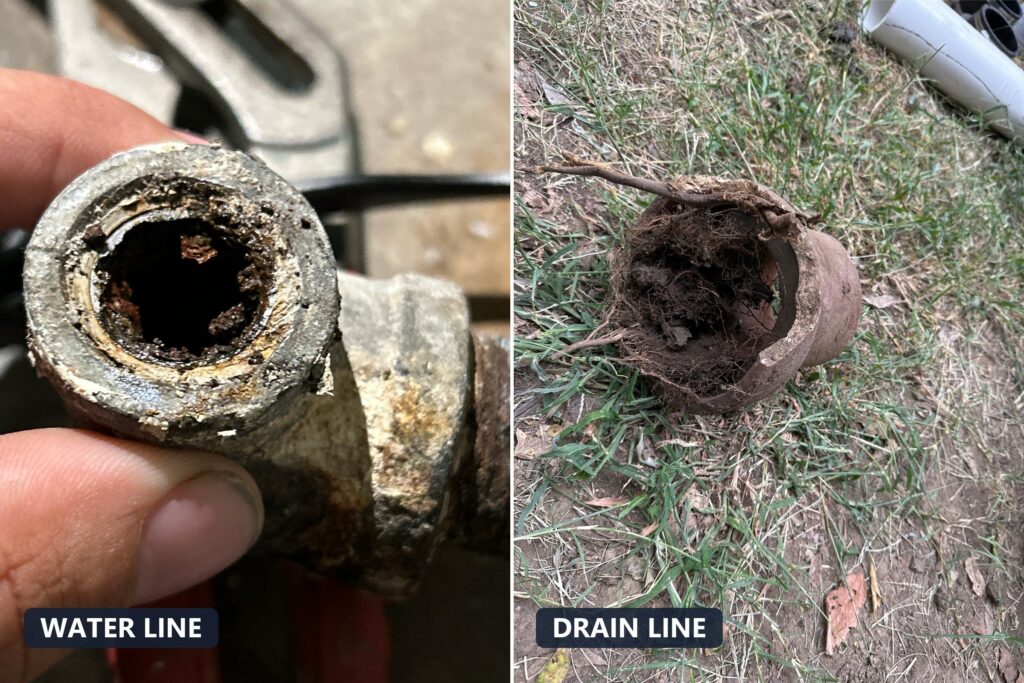
What are the signs of failing pipes in an older home? The answer depends on which pipes you mean, because every house has two systems. The water lines bring water in under pressure, and the drains carry everything out by gravity. They’re made of different materials, they age on different clocks, and they fail in different ways. A water line is pressurized, so a failure shows up as a water bill that jumped or a warm spot on the floor. A drain line is quieter. It shows up as repeat backups, gurgling, or a smell.
Here’s what each system usually looks like in an older Tulsa house, the signs that one of them is wearing out, and how we find out which one you’re dealing with.
What’s Under an Older Tulsa House
In a house from the 1950s, it’s usually cast iron under the slab and clay out in the yard on the drain side. Houses from the mid 1940s to the early 1970s can also have Orangeburg, a tar paper sewer pipe with a short lifespan. On the water side, a lot of Tulsa’s older neighborhoods are still on their original galvanized steel.
Cast iron gives you 50 to 75 years before the bottom channels out, and galvanized can easily last 60 to 70 years. A lot of midtown Tulsa is sitting in those windows now. Age alone doesn’t mean a pipe has failed, but it tells you what to watch for. If you’re not sure what your water lines are made of, our guide on how to know if your house needs repiping walks through the magnet test and the other quick checks.
Signs Your Water Lines Are Wearing Out
We’ve covered the water side in detail in our posts on when to repipe a house and galvanized pipe replacement, so here are the short versions.
Leaks in more than one place
One leak is a repair. Leaks in different parts of the house inside the same year is a repipe. Copper corrodes from the inside out, so a pinhole says more about the run than the spot. The first pinhole is a repair. The second in the same house means the whole run.
Low pressure, or a hot side weaker than the cold
Galvanized scales up on the inside until less water can get through. One tell is a hot side noticeably weaker than the cold, because the hot lines scale up first. Flakes in your water or rust colored water belong on the same list.
A water meter that moves with everything off
Your water meter will tell you before your eyes will. Shut off every faucet, the ice maker, and the irrigation, then watch the small triangle on the meter. If it’s still moving, water is going somewhere. Check the toilets first, the quietest water thief in a house: drop food coloring in the tank, don’t flush, and look in the bowl in fifteen minutes. Color means the flapper is passing water, and that’s a cheap fix you can do yourself.
Signs Your Drain Lines Are Wearing Out
The drain side is where an older house usually has something new to tell you. These are the signs we hear about most.
Repeat stoppages, gurgling, and smell
Repeat stoppages, gurgling, and smell are the three you’ll notice first. If your main line gets cabled once or twice a year, that isn’t bad luck, that’s a pipe telling you something.
The lowest fixture backs up
When water comes up in the lowest fixture, usually a tub or shower, the blockage is out in your main line, so everything you send down comes back up somewhere. A toilet that backs up when you run other fixtures points the same way.
Green or soggy strips in the yard
One strip of grass greener than the rest of the yard belongs on the list too, and so does a soggy patch with no rain to explain it.
Damp carpet in one spot
Under the slab, a drain line problem looks different from a water line problem. A water line under the slab shows up as a water bill that jumped or a warm spot on the floor. A drain line shows up as repeat backups or damp carpet in one spot. Read your meter with everything off. If it’s still creeping, that’s the pressurized side. If it isn’t, the drains move up the list.
What’s Happening Inside an Old Drain Line
Cast iron wears through along the bottom
Cast iron gives you 50 to 75 years before the bottom channels out, and scale builds up inside it along the way. You can’t see any of that from the outside, which is why the camera matters on an older house.
Clay lets roots in at the joints
Roots find the joints in clay sewer pipe. We cut them with a cable machine and that gets you flowing today, but it does nothing about the crack they came through, so they’ll be back. Pay to have them cut two or three times a year and you’ve already spent the repair money, you just don’t have the repair.
Bellies from Tulsa clay
A belly is a low spot where the pipe lost its fall, so waste sits in it. Around here that’s Tulsa clay moving with the wet and dry cycles. You can’t clean it out or line it away, because the grade failed, not the pipe. The fix is to re-bed that section at the right fall.
Orangeburg
Orangeburg is tar paper pipe with a short lifespan. When the camera finds it failing, that’s a replacement conversation, not a cleaning one.
How We Find Out Which System It Is
On the water side, we isolate and pressure test sections ourselves and run acoustic gear that hears water under concrete. On the drain side, it’s the camera. It shows what’s actually wrong, which is the difference between a repair and a guess: roots at a joint, a crack, an offset, scale inside cast iron. A locating sonde on the camera head paints the path and depth on the ground, so if something has to be opened, we open only that area.
A camera can’t see through a stoppage, so a backed up line gets cleared first. Our sewer and slab services page has more on camera work and sewer repair.
Spot Repair or the Whole Line?
It depends on what the camera shows. One failed section, say a root at a single joint, is a spot repair. Clay with roots at every joint, or cast iron channeled end to end, and a spot repair moves the next failure ten feet down the pipe. The water side works the same way: one leak is a repair, and a pattern of leaks is a repipe. Our post on home repipe cost covers what that runs.
Either way, we’ll tell you which one you’re looking at, even when it’s the cheaper one. A spot sewer repair is often a one day job. For a sewer replacement and most repairs, we pull the permit, and our labor carries a one year warranty.
Not Sure Which System Is Acting Up?
When you call, tell us what you’re seeing: which fixtures, how often, and whether your water meter moves with everything off. That helps us bring the right equipment the first time. Call Tulsa Plumbing & Remodeling at (918) 800-4426. We offer same-day service when the schedule allows.