
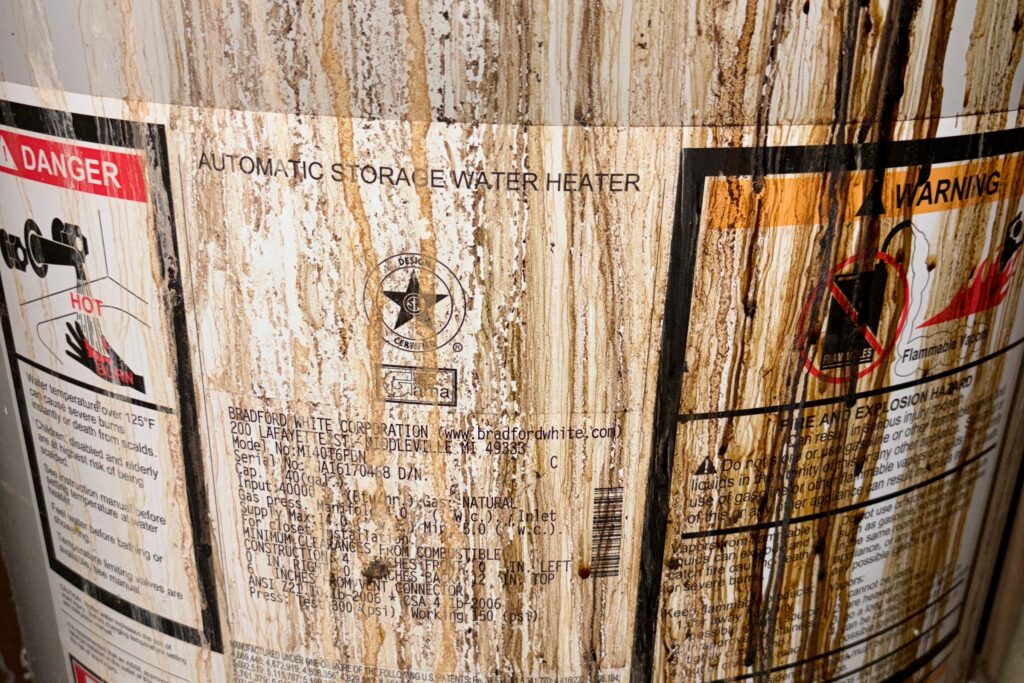
When a water heater leaks, the first question is where the water starts. A valve or a fitting that’s leaking is often a repair. A tank that has rusted through is a replacement, because nobody can fix that. Here’s what to do first, and how to tell which one you have.
If There’s Water on the Floor Right Now
Shut the valve on the cold line going into the top of the tank. Then shut off the gas to the heater, or the breaker if it’s electric, and call us at (918) 800-4426.
Don’t skip the breaker on an electric heater. The elements burn up if they’re energized in an empty tank.
If that valve won’t close, or the water is coming from somewhere else, shut off the main. Round handle, turn it clockwise until it stops. Straight lever, a quarter turn so it sits crossways to the pipe. In most Tulsa homes it’s near the front hose bib, in the garage, or in a utility closet. If it won’t turn with normal hand pressure, don’t force it.
Where Is the Water Coming From?
Under the tank
Water coming from under the tank means it rusted through from the inside, and nobody repairs that. A tank that’s leaking isn’t repairable at any price, by anybody. That one is a replacement.
The pipe on the side
The pipe coming off the side of the tank is the temperature and pressure relief line, the T and P. When water drips out of it, the valve is doing its job. It opens past about 150 psi or 210 degrees and dumps the water at the floor.
A steady drip means something else is wrong: high water pressure, a waterlogged expansion tank, or a thermostat set too hot. Never cap that pipe.
The drain valve near the bottom
The drain valve near the bottom of the tank is the boiler drain. Many manufacturers ship a plastic one, and it’s usually the first part to fail. You can’t swap it for brass later without voiding the warranty on the whole heater, so every water heater we set already has a brass boiler drain.
A leak at a valve or a fitting is a different story from a leak in the tank, and it’s often repairable.
The fittings on top
The cold line comes into the top of the tank. If the water starts at a fitting up there, that’s a fitting, not the tank, and it’s often repairable too.
Why the Relief Valve Keeps Dripping
A pressure reducing valve or a check valve on your main makes a closed system, and heated water has nowhere to expand. Without an expansion tank you get a dripping T and P valve and banging pipes.
If you already have an expansion tank, the bladder inside it gives up around 5 to 10 years. We check it on every water heater visit.
High pressure does it too. Anything over 80 psi is above code, and high pressure shortens the life of your faucets, supply lines, water heater and toilet parts. We put a gauge on a hose bib to read it, and the fix is usually a pressure reducing valve. Those last 10 to 15 years and fail in either direction.
Repair It or Replace It?
Age decides this more than the symptom does. Early on, thermocouples, gas valves, elements and thermostats are normal wear parts worth fixing. Past 12 years we start recommending replacement.
Water heaters last 6 to 15 years, but past the decade mark you should be budgeting. Not sure how old yours is? Text a photo of the data plate to (918) 800-4426 and we’ll tell you. Anything over 20, gently pat it on the back and give us a call.
Thinking about tankless?
If the tank has to go anyway, it’s a fair question. Tankless gives you endless hot water and your floor space back, but the install costs more, and a gas unit usually needs a bigger gas line and a different vent. With Tulsa’s hard water, descaling is maintenance you have to keep up with, and we do it in house. Our post on tankless vs tank water heaters goes through the tradeoffs.
What Leak Repairs Cost
We give you the price before we start work, so there aren’t any surprises when you get the bill.
On our published price list, replacing a broken water heater drain valve runs $250 to $500, an expansion tank replacement $350 to $675, and a general water heater repair $450 to $900.
When the tank itself is leaking, the fix is a new heater: a 50 gallon gas heater runs $1,100 to $2,075, a 40 gallon electric $975 to $1,850, and a 30 gallon electric $850 to $1,600. Our post on tank water heater replacement walks through sizing and what install day looks like.
Permits and Who Supplies the Heater
Replacing a water heater usually takes a permit, and we pull it under our Oklahoma plumbing license, #180753. We’re registered in Tulsa County, Rogers County and every metro city. The permit means somebody other than the installer checks the gas connection, the venting and the T and P discharge. If a bidder says it isn’t necessary, get a second opinion.
We install Rheem, A.O. Smith or Bradford White in a quality model, and we don’t install heaters we didn’t supply. If a heater we installed fails, you call us, not an 800 number. We keep your model, serial and install date on the job, deal with the manufacturer for you, and haul the unit back ourselves.
Need a Hand With a Leaking Water Heater?
Call us at (918) 800-4426 and tell us where the water is coming from, whether the heater is gas or electric, and how old it is. A photo of the data plate helps.
Our guys photograph the work as they go, so you’ll see what we found. Say the word and we’ll send you the set. Our water heater page covers the rest of what we do with tank and tankless heaters.