
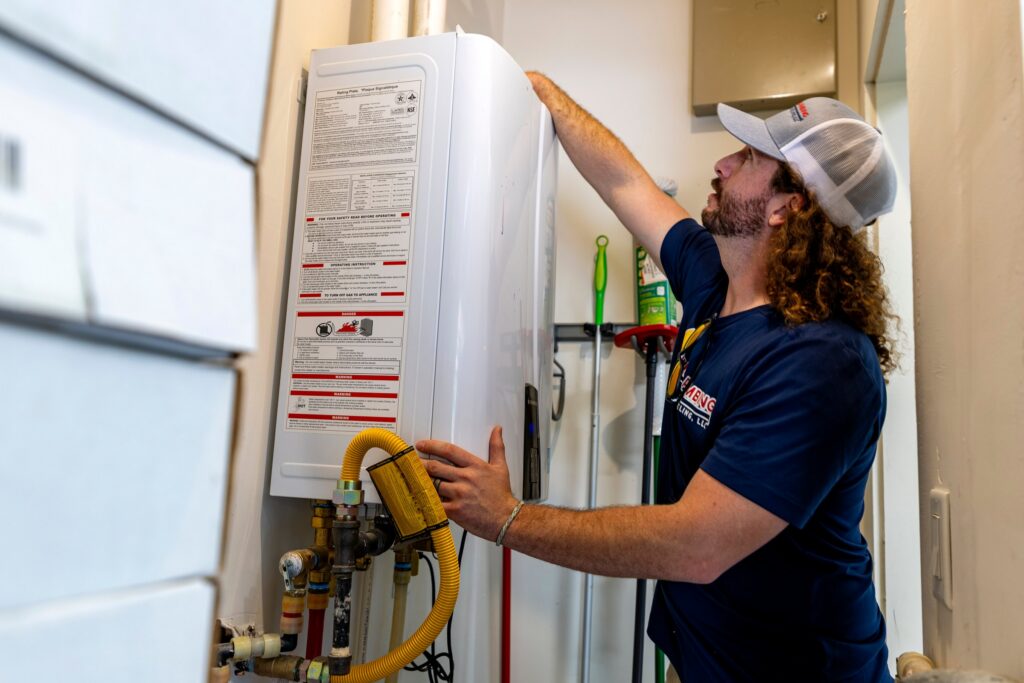
Tank or tankless is one of the first questions people ask when a water heater goes out, and the honest answer depends on the house more than the heater. If you’re weighing a tankless vs. tank water heater and trying to figure out which you should choose, here are the questions homeowners actually ask us, answered the way we’d answer them standing in your utility closet.
The numbers below come from our own price list and our own jobs, not national averages.
Cost: what each one runs
How much does a tank water heater cost to replace?
On our published price list, a 50-gallon gas tank runs $1,100 to $2,075 installed. A 40-gallon electric runs $975 to $1,850, and a 30-gallon electric runs $850 to $1,600. That covers the new heater, labor, standard connections, and removing the old one. If your system needs an expansion tank, that adds $350 to $675.
How much more does a tankless cost to install?
Meaningfully more, and the unit is only part of it. The bigger variable is what your house needs to accept one. That can mean upsizing the gas line, new venting and combustion air, and isolation valves. Our recent tankless installs have run about $3,500 to $4,700, and we provide pricing before we start work so there aren’t any surprises.
Is a tankless water heater actually worth it?
For the right house, yes. You’re trading a higher install cost and real maintenance for hot water that doesn’t run out, a smaller gas bill, and the floor space back. Where it doesn’t pay off is light hot water demand, and we’ll tell you when a good tank is the smarter buy.
Hot water: what you actually get
Do I really get endless hot water with a tankless?
Endless, yes. Unlimited, no. Stay under its flow rate and it heats all day, but ask for more than it’s sized for and it just hands you cooler water. Shut a faucet off and back on and you get a slug of cool water, the industry’s cold water sandwich, and yes, that’s really the name.
Can two people shower at once?
On a tankless, flow rate and temperature rise go together, and people skip the rise. Tulsa winter water comes in near 50 degrees, so a unit rated at 11 gallons per minute really gives you about half that in January. Two showers at once is usually fine on a properly sized gas unit.
A tank works the other way. It hands you the hot water it’s holding right away, then makes you wait while it recovers. Sized right for your household, most families never notice. Sized too small, the last shower of the morning finds out. Gas tanks recover faster than electric ones.
What your house needs for a tankless
Does my gas line have to be upgraded?
More often than not, yes. A 50-gallon tank burns around 40,000 BTU and a whole-house tankless runs 150,000 to 199,000, so the half-inch line that fed your old tank almost never covers it. Our Oklahoma license (#180753) covers gas piping, we do our own gas work, and we pull the permit.
Can I reuse the vent from my old water heater?
Almost never. Your old tank drafted up a B vent, and a modern tankless is sealed combustion that needs its own dedicated venting, usually PVC or stainless out a side wall with a matching air intake. If the tank shared a flue with your furnace, that flue is now oversized.
Can I put in an electric tankless and skip the gas work?
For one sink or a shop bathroom, an electric point-of-use unit is fine, and we install them. For a whole house in Oklahoma it’s usually the wrong answer, because it wants three or four dedicated 40-amp breakers and a service upgrade that costs more than the gas work you were avoiding.
Upkeep and lifespan
How long does each one last?
A well-maintained tankless should give you around 20 years, against the 6 to 15 you’d expect from a conventional tank. The parts on a tankless are serviceable too, so an older tankless is often worth repairing. On tanks, our rule is simple: once one is past 12 years old, we recommend replacing it, even when a repair would technically work.
What maintenance does a tankless need?
Descaling, and in Tulsa it isn’t a suggestion. Our water is hard, and the scale it leaves narrows the heat exchanger until you get flow codes and an early failure. Descaling means circulating vinegar or the manufacturer’s solution through the unit with a pump, and we won’t set a tankless without isolation valves.
A full annual service is more than the acid flush. We rinse the inlet water filter screen, inspect the burner, and check combustion and gas pressure while the unit is firing, which is the only time an undersized gas line shows itself. Under an hour, once a year. Tankless descaling runs $425 to $850 on our price list.
What maintenance does a tank need?
A yearly flush and tune-up, which runs $250 to $500 on our price list. We flush out the sediment, check the anode rod, and test the temperature-and-pressure relief valve. Every tank we install gets a brass drain valve, because the plastic ones many manufacturers ship are usually the first part to fail.
Buying and installing
Which brands do you install?
For tanks, Rheem, A.O. Smith, and Bradford White, bought through local supply houses rather than big-box stores. For a tankless, we pick the model to fit your gas line and venting. Every installation carries our one-year labor warranty, and the heater itself carries the manufacturer’s warranty.
Will you install a water heater I buy online or at a big box store?
We don’t install customer-supplied water heaters. Your warranty is as good as the person that warranties it, and when we buy from Winnelson or Locke we can carry a failed unit in and talk to a person. On the rare exception, the estimate says so in writing and we don’t warranty the unit.
Tankless vs. tank: which should you choose?
Here’s how it usually shakes out:
- Choose a tank if your hot water use is light to average, you want the lowest install price, or your gas line and venting would need major work to take a tankless.
- Choose a tankless if your household uses a lot of hot water at once, you plan to stay in the house long enough to get the most out of a unit that can last around 20 years, and your house can take the gas line and venting it needs.
- Either way, plan on yearly maintenance. Tulsa’s water is hard on both.
Still not sure? Call Tulsa Plumbing & Remodeling at (918) 800-4426. We’ll look at your gas line, your venting, and how your household uses hot water, and tell you which one fits. If a good tank is the smarter buy, we’ll tell you that too.