
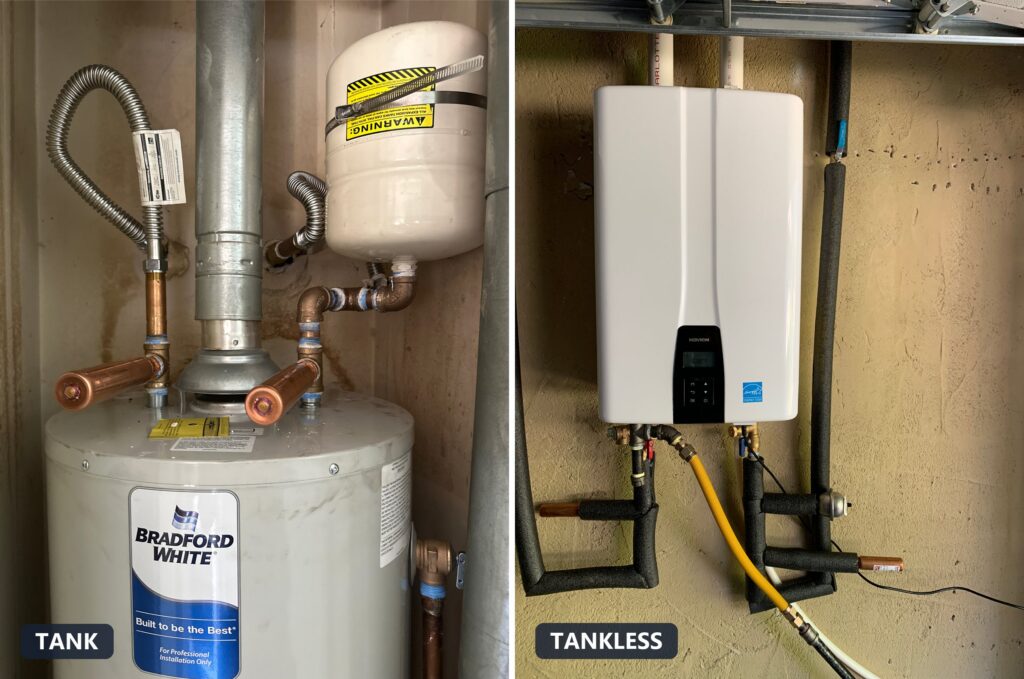
What is the best water heater for a Tulsa home? The honest answer depends on four local factors: your fuel source, available space, household size, and budget. Tulsa’s municipal water averages 5.2 to 8.2 grains per gallon depending on the treatment plant, which ranges from moderately hard to hard, and that mineral content speeds up buildup inside any water heater. Tulsa winter water comes in near 50 degrees, which cuts a tankless unit’s delivered output. Many Tulsa homes already have natural gas service, and that shapes the whole conversation before you ever look at a brand. This guide covers each water heater type, what it actually costs installed in Tulsa, how to size it correctly, and which rebates are worth checking right now. At Tulsa Plumbing & Remodeling, we install tank and tankless water heaters in homes from midtown to south Tulsa and everywhere in between.
Why Tulsa’s Local Conditions Should Guide Your Choice
Hard Water and What It Means for Your Equipment
Tulsa’s water hardness varies by treatment plant: the City of Tulsa reports averages of 5.2 grains per gallon for its Mohawk plant and 8.2 for its A.B. Jewell plant. That mineral content matters, and its impact isn’t equal across heater types. Conventional tank units accumulate sediment at the bottom over time, which annual flushing keeps under control. Tankless heat exchangers are more vulnerable because scale narrows the internal passages where water contacts the heat source, reducing efficiency and eventually triggering failure. Running a tankless unit in Tulsa without either a water softener or a regular descaling schedule noticeably shortens its lifespan.
Our tankless descaling service runs $425 to $850 depending on the unit, and in Tulsa it isn’t a suggestion: plan on it once a year. Hybrid heat-pump heaters are less affected because water contacts a storage tank rather than a tight heat exchanger.
Oklahoma’s Climate and How It Affects Hot Water Delivery
Tulsa doesn’t see the sustained deep freezes that northern states do, but winter water still comes in near 50 degrees. For a tankless unit, that means raising the temperature about 70 degrees to reach 120°F at the tap, and the bigger the rise, the lower the flow. A unit rated at 11 gallons per minute really gives you about half that in January. Always ask for the manufacturer’s flow chart at a 70-degree rise before buying. Sizing for Tulsa’s actual winter conditions, rather than the peak spec on the label, is where many homeowners get caught off guard.
What Is the Best Water Heater for a Tulsa Home? Tank, Tankless, or Hybrid
Conventional Tank Water Heaters
A standard tank unit stores 30 to 80 gallons of preheated water, ready the moment you open the tap. Gas models recover faster than electric, which matters in households where back-to-back showers are the norm. Tank heaters are the most straightforward to install, require the fewest infrastructure changes, and carry the lowest upfront cost of the three types. For most Tulsa households of four or fewer people with existing gas service, a properly sized gas tank is the practical, reliable choice: no surprises and no complicated maintenance schedule.
Tank water heaters have one real weakness: standby heat loss. The unit keeps a full tank at temperature around the clock, even when no one’s home. In a well-insulated modern unit that loss is modest, but it’s a real operating cost over time. For most Tulsa households, the installation cost advantage and simpler maintenance still tip the scales in favor of the tank.
Tankless Water Heaters
Tankless units heat water on demand and, in theory, never run out. That appeal is real for households with high simultaneous hot water demand or for homeowners who want to eliminate standby heat loss entirely. The trade-offs are a higher installation cost, more complex venting and gas-line requirements, and greater maintenance demands in Tulsa’s hard-water environment.
The key number to verify before committing to a tankless unit is the GPM rating at about a 70-degree temperature rise, not the peak spec printed on the box. If a unit can’t keep up with simultaneous demand on a cold January morning, the investment doesn’t deliver what the homeowner expected. Tankless installation costs vary considerably based on venting type, gas line capacity, condensate drainage, and whether the ignition system requires an electrical upgrade, so we assess all of that during the estimate.
Hybrid Heat-Pump Water Heaters
A heat-pump (hybrid) unit pulls heat from the surrounding air and transfers it into the water. The U.S. Department of Energy rates heat-pump water heaters as two to three times more energy efficient than conventional electric tanks, which can mean meaningful savings on monthly bills. The space requirements are real, though: a hybrid unit needs roughly 700 to 1,000 cubic feet of surrounding air, a condensate drain, and an installation space that stays above about 40°F year-round.
In Tulsa, an unconditioned basement, a spacious utility room, or a garage that doesn’t freeze can be a solid fit. A tight utility closet is not. Homes without adequate space aren’t good candidates regardless of the efficiency numbers. Force a hybrid heater into an undersized space and it falls back on electric-resistance mode, erasing most of the savings.
Matching Water Heater Size to Your Household
Tank Sizing by Household Size
Getting the tank size right matters more than brand selection. A tank that’s too small runs cold before everyone has showered; one that’s too large wastes energy heating water that sits unused. Here are practical starting points:
- 1 to 2 people: 30 to 40 gallons
- 3 to 4 people: 50 gallons
- 5 to 6 people: 65 to 75 gallons
Electric tanks recover more slowly than gas, so if you’re going electric, move up one size within those ranges. Hybrid heat-pump units recover more slowly still, so households of four or more should start at 65 gallons.
Tankless GPM Ratings: What to Actually Verify
A tankless unit’s box rating is usually measured at a 35-degree temperature rise. In a Tulsa January the heater needs about a 70-degree rise, so size it by its flow at that rise and by how many fixtures you run at once, not by the number on the box.
Two showers running at the same time use roughly 4 to 5 gallons per minute, so size for simultaneous peak demand, not average use. Two showers at once is usually fine on a properly sized gas unit. Undersizing is a common reason homeowners end up unhappy with a tankless install, and no tankless repair can fix a unit that’s simply too small for the house.
Real Tulsa Installation Costs, Broken Down Honestly
What a Standard Tank Replacement Costs With Us
For a straightforward like-for-like tank replacement, our installed prices are: 50-gallon gas, $1,100 to $2,075; 40-gallon electric, $975 to $1,850; 30-gallon electric, $850 to $1,600. These are Tulsa Plumbing & Remodeling’s published price ranges and include the new heater, labor, standard connections, and removal of the old unit. Every water heater we install gets a brass drain valve, because the plastic valves many manufacturers ship are usually the first part to fail. Our labor carries a one-year warranty on every installation.
We don’t install customer-supplied water heaters. On the rare exception, we note it on the estimate in writing, and that installation carries no warranty. A warranty is only as good as the person who stands behind it, and because we buy our heaters through local supply houses, we can carry a failed unit in and talk to a person.
What Drives Tankless Installation Pricing
Because every tankless installation is different, we don’t publish a flat rate. Our recent tankless installs have run about $3,500 to $4,700. The main cost drivers are:
- Venting: Condensing units need their own PVC vent runs and non-condensing units need stainless steel venting; the old tank’s vent almost never carries over
- Gas line capacity: A whole-house tankless burns 150,000 to 199,000 BTU, against about 40,000 for a 50-gallon tank, so the half-inch line that fed your old tank almost never covers it
- Condensate drainage: Required on condensing models and not always easy to route
- Electrical requirements: Ignition systems and controls may require a dedicated circuit
A straightforward swap of an existing tankless unit on an already-capable gas line costs far less than converting from a tank system. We assess all of it during the estimate, before any work starts.
Additional Costs Worth Budgeting For
An expansion tank is required on closed plumbing systems, such as a home with a pressure-reducing valve. If your existing expansion tank is at end of life or was never installed, replacement runs $350 to $675. A flush and tune-up on an existing tank, useful if you’re deciding whether to repair or replace, runs $250 to $500. We pull the permit, which in Tulsa means a City of Tulsa plumbing permit and a required inspection to keep the work code-compliant.
Brands We Install and Rebates Worth Checking Before You Buy
The Brands We Work With
For tank heaters we install Rheem, A.O. Smith, and Bradford White, bought through local supply houses rather than big-box stores. For tankless units, brand and model selection depends on your venting configuration, existing gas line size, and whether a recirculation system is already in place. We specify the right model for your setup at the time of the quote rather than defaulting to a single brand regardless of the situation.
Oklahoma Rebates and Incentives in 2026
The rebate landscape has shifted this year, and it’s worth getting the facts straight before buying. The federal 25C energy efficiency tax credit, which previously offered up to 30% back on qualifying heat-pump water heaters, ended for installations placed in service after December 31, 2025. Do not rely on contractor websites or cost guides that still advertise that credit for 2026 purchases.
As of October 2026, PSO advertises a $500 rebate on a qualifying ENERGY STAR heat-pump water heater through its Power Forward program. You need an active PSO residential account and approved equipment, so confirm current terms and available funding with PSO before purchasing.
For gas water heaters, ONG (Oklahoma Natural Gas) lists four rebates for 2026: $325 for a gas tankless unit with a UEF of 0.80 or higher, $650 for a new condensing gas tank with a UEF of 0.80 or higher, $1,050 for replacing an electric water heater with a new gas water heater, and $1,375 for replacing an electric water heater with a qualifying gas tankless unit. ONG pays first-come, first-served while program funds last, and the application is due within 180 days of installation. If your home is served by a utility other than PSO or ONG, check with that provider directly; Oklahoma does not have one universal statewide rebate.
Getting the Right Recommendation for Your Specific Home
There is no single best water heater for a Tulsa home. The right answer depends entirely on your specific situation. A household of two in a midtown bungalow with gas service and a small utility closet has a completely different answer than a family of five in a newer south Tulsa home with a spacious utility room and a 200-amp panel. When you call Tulsa Plumbing & Remodeling, we look at your current setup, your household’s peak hot water demand, your available fuel source, and the physical space before recommending anything. We don’t upsell you into a tankless unit if a well-sized tank will serve your household just as reliably for less money.
We offer same-day service when the schedule allows, and scheduled quotes for planned upgrades. You’ll have the price before work starts, we pull the permit, and every installation carries our one-year labor warranty. You can reach us at (918) 800-4426. When you call, have your household size, current fuel type, and any recurring issues ready. Running out of hot water, rising utility bills, or discolored water all help us come prepared with a right-sized recommendation rather than a generic one. Our crews work on everything from 1940s midtown homes to new south Tulsa builds, and that experience shows in how we size, spec, and finish every job.
Choosing a water heater is a 10-to-15-year decision, and the installed cost is only part of the picture. Fuel costs, maintenance demands, and Tulsa’s specific water conditions all shape how a unit actually performs over its life. Still asking what is the best water heater for a Tulsa home? Call us and we’ll give you a straight answer based on your house, not a brochure.