
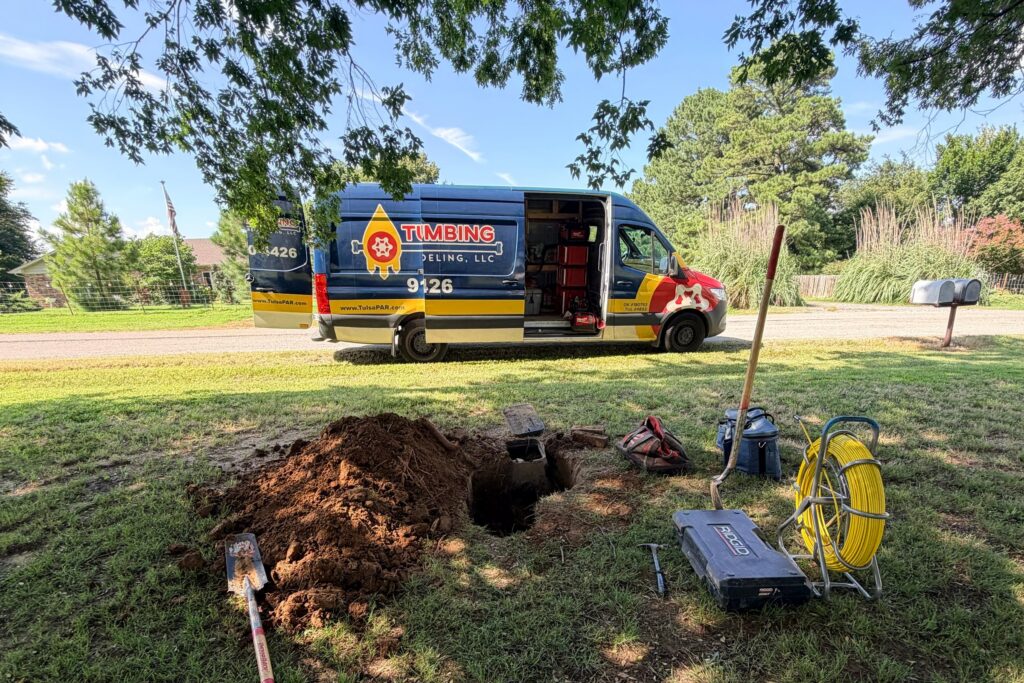
Water leak detection is how we find a leak you can’t see, without opening up more of your house or yard than the repair needs. Your water meter will tell you about a hidden leak before your eyes will. From there it’s a process of elimination: inside or outside, water line or drain line, and then the exact spot. Here’s how we work through it, and the checks you can run yourself first.
If Water Is Showing Up Right Now
Shut the water off, then call us at (918) 800-4426. The main shutoff is usually where the line enters the house, and in most Tulsa homes that’s near the front hose bib, in the garage, or in a utility closet. Round handle, turn it clockwise until it stops. Straight lever, a quarter turn so it sits crossways to the pipe. If it won’t turn with normal hand pressure, don’t force it, call us.
A single fixture has its own stop valve under the sink or behind the toilet. Then get the floor dry and put a fan on it, because water sitting turns a pipe bill into a drywall bill.
Signs of a Hidden Leak
A leak you can’t see still leaves tracks. A water bill that jumped when nothing changed. Water you can hear running with everything in the house turned off. Damp spots, soft flooring, or discoloration on a wall or ceiling. A musty smell that won’t go away. On a slab, a warm spot on the floor points to a water line leaking underneath.
Outside, watch for a soft patch that stays wet, or one strip of grass thriving through an August dry spell. And if your water pressure dropped all over the house at once, a main line leak is one of the usual causes, along with a failing pressure reducing valve, a softener stuck in bypass, or galvanized pipe silted shut.
Any one of those could have another explanation, so start with the meter.
Start With Your Water Meter
Shut off every faucet, the ice maker, and the irrigation, then watch the small triangle on the meter. If it’s still moving, water is going somewhere.
Rule out the toilets first
Toilets are the quietest water thief in a house. Drop food coloring in the tank, don’t flush, and look in the bowl in fifteen minutes. Color in the bowl means the flapper is passing water, and that’s a cheap fix you can do yourself. A running toilet keeps your meter moving just like a hidden leak would, and you pay for that water on the sewer side too.
Inside the House or Out in the Yard?
If the toilets check out and the meter is still moving, close your main shutoff at the house and watch the meter again. If it keeps moving with the main closed, the leak is outside, on the buried line between the meter and your house. Tell us that when you call, because it changes where we start.
If the meter stops when the main is closed, the water is going somewhere past that valve: a fixture, a line in a wall or ceiling, or a line under the slab.
Outside, it helps to know whose pipe it is. You own the water line from the outlet side of the meter to the house. The city owns the main in the street and the meter itself, which is news to a lot of homeowners the first time a service line fails. If the leak turns out to be on the city’s side, we’ll tell you, since that’s their pipe.
How We Find a Leak in the Yard
The wet spot is usually nowhere near the break. Water follows the path of least resistance, so it can surface well away from where the pipe failed, which is why we trace the line end to end before anybody digs. There’s no reason to open the whole run between the meter and your foundation.
First we trace the line
How we trace it depends on what it’s made of. On copper or galvanized, we clip a radio detection transmitter to the metal at the meter and walk the yard with a receiver, mapping the route and depth. PEX, poly, and PVC carry no signal, so we energize the tracer wire if there is one, and if there isn’t, we work from the two known ends. A lot of older Tulsa homes are still on galvanized, which for once makes them the easy ones.
Then we listen for it
With the route mapped, we run acoustic listening equipment along it and follow the sound of water escaping the pipe, which narrows the leak to a small area. That gear is ours, and our own guys run it.
Then we mark it
Every locate gets marked, and you don’t have to ask. We paint and flag the route in standard utility colors, blue for water and green for sewer. Paint doesn’t survive a rain and a mow, so we also write the depth down, measure off the meter box, and send you photos.
How We Find a Leak Inside or Under the House
Inside, we isolate and pressure test sections of the plumbing ourselves, so we know which line is losing water before anything gets opened. On a slab, that means testing the hot and cold lines separately to see which side is failing. Then acoustic gear lets us hear water escaping under the concrete, so the opening goes where the leak is.
A leak in a wall or ceiling usually shows itself as a damp spot or discoloration. Once we know which line it is, we cut the access we need, keep the cuts small, and tell you where they’re going before we start. Putting the wall back is drywall and paint work, which isn’t our trade, and we’ll say so up front.
Drain lines are a different animal
A water line is under pressure all the time, so a leak in it moves your meter. A drain line isn’t, so your meter looks normal and the signs are quieter: repeat backups, or damp carpet in one spot. For a drain, a camera inspection shows the break. Our sewer and slab services page covers that side.
Once We Find It
On a buried line, we dig where we marked it, not the whole run. But a line patched three times, or galvanized rusting from the inside out, will fail somewhere else, and we’ll price a new service line instead of a fourth repair.
Inside, one leak is a repair. Leaks in different parts of the house inside the same year is a repipe. In between, it comes down to the material, the age, and how close together the leaks came, and we’ll tell you which one you’re looking at, even when it’s the cheaper one.
Under the slab, we either open the concrete and replace that section, or run a new line overhead through the attic. We do both in house. Our post on slab leak repair walks through those options.
Insurance and Photos
We photograph what we find on every leak call, whether you file a claim or not. On coverage, read your policy or call your agent. Policies generally cover sudden, accidental water damage and not the pipe that caused it, and a slow leak seeping for months gets denied as maintenance.
What Leak Detection Costs
There’s no flat price for finding a leak. It depends on where the leak is, how long the line runs, what it’s made of, and how easy it is to get to both ends. We provide pricing before we start work, so there aren’t any surprises when you get the bill. And if we open a wall and find something nobody could have seen from the outside, we stop, re-price it with you, and you’re the one who says go.
Think You Have a Hidden Leak?
Read your meter with everything off. If it’s moving and the toilets check out, call us at (918) 800-4426. We’ll narrow it down, mark it, and give you a price before any work begins. Our leak repair and repiping page covers the repair side, and our water line location page covers buried lines.