
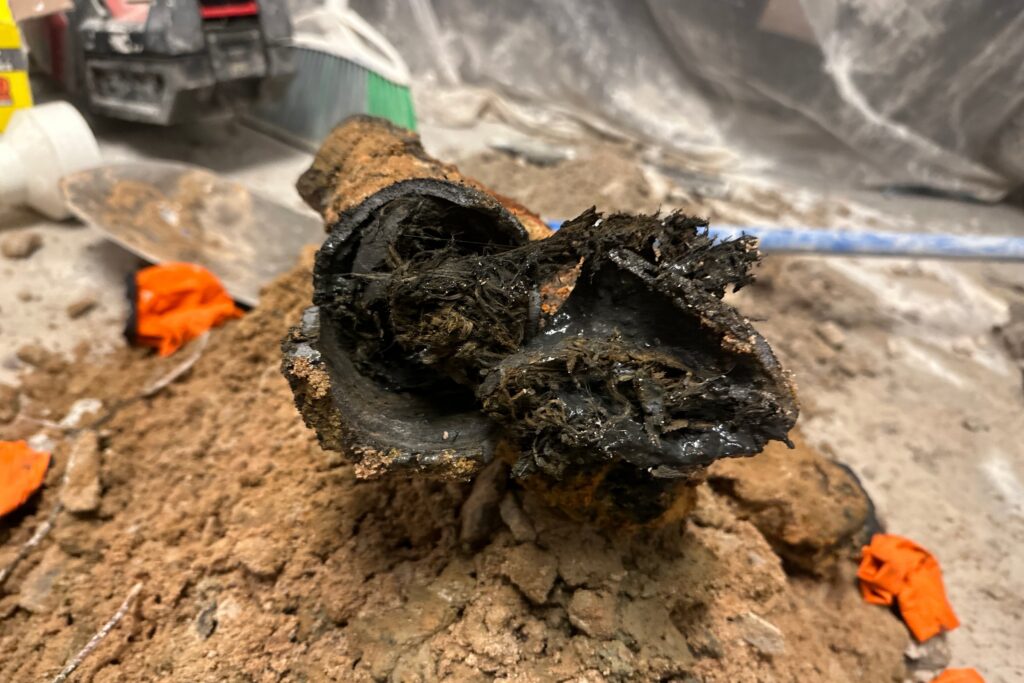
Sewer line repair comes down to two questions: what failed, and where is it? Your sewer line is the main artery carrying waste out of your home, and when it fails from roots, corrosion, ground shifting, or plain age, the right fix depends on what a camera finds. Here’s how we work through a sewer repair, from the first warning signs to the day the trench gets backfilled.
Signs Your Sewer Line Needs More Than a Cleaning
Repeat stoppages, gurgling, and smell are the three you’ll notice first. Gurgling from several drains at once, or a toilet that backs up when you run other fixtures, points past any one drain and out to the main line.
Check the yard too. Soggy patches with no rain to explain them belong on the list, and so does one strip of grass greener than the rest of the yard.
And if your main line gets cabled once or twice a year, that isn’t bad luck, that’s a pipe telling you something.
If Sewage Is Coming Up Right Now
Stop running water in the house. When sewage comes up in the lowest fixture, usually a tub or shower, the blockage is out in your main line, so everything you send down comes back up somewhere. Don’t flush, don’t run the dishwasher, and stop the washer mid cycle.
If your outside cleanout cap comes off easy, letting it relieve into the yard beats it coming up in your floor. If it’s tight or you hear pressure behind it, leave it for us and call (918) 800-4426. Our post on drain cleaning in Tulsa covers what happens once we get there.
What Usually Goes Wrong
Most of the sewer failures we find fall into a few groups.
Roots at the joints
Roots get in at a joint or through a crack. We can cut them out with a cable machine, and sometimes that’s the right call, because it gets you flowing today. A jetter goes further and scours the pipe wall with high pressure water, though on old clay or thin cast iron we want camera footage first. Neither one does anything about the crack the roots came through, so they’ll be back. Our post on hydro jetting covers the cleaning side in more detail.
A belly in the line
A belly is a low spot where the pipe lost its fall, so waste sits in it. Around here that’s Tulsa clay moving with the wet and dry cycles. You can’t clean it out or line it away, because the grade failed, not the pipe.
Cast iron that has channeled out
In a house from the 1950s, figure cast iron under the slab and clay out in the yard. Cast iron gives you 50 to 75 years before the bottom channels out, and a lot of Tulsa midtown is sitting in that window now.
Orangeburg pipe
Houses from the mid 1940s to the early 1970s can also have Orangeburg, a tar paper pipe with a short lifespan.
The Camera Decides the Repair
A camera inspection shows what’s actually wrong, which is the difference between a repair and a guess. Roots at a joint, a crack, an offset, scale inside cast iron: it all shows up on the screen. A locating sonde on the camera head paints the path and depth of the line on the ground, so we know exactly where the problem sits.
A camera can’t see through a stoppage, so a backed up line gets cleared first. On our price list, a camera inspection of the sewer line runs $200 to $400, and you get the video findings along with our recommendation.
Spot Repair or Full Replacement?
It depends on what the camera shows. One failed section, say a root at a single joint, is a spot repair. A belly gets fixed by re-bedding that section at the right fall.
Clay with roots at every joint, or cast iron channeled end to end, is a different story. A spot repair there just moves the next failure ten feet down the pipe.
Where the Break Is Changes the Job
Out in the yard
A yard repair means opening the ground over the bad section, replacing the pipe, and backfilling. A spot repair is often a one day job, and most full sewer replacements are completed and backfilled in under two days.
Under the house
Usually the floor has to come up. We don’t tunnel under homes, so we open the concrete from inside and work from above. The sonde on the camera head marks the spot and depth in paint on your floor first, so we open only that area. Under slab work runs longer, because getting to the pipe is most of the work.
We do the plumbing. The concrete goes back, but tile, wood, carpet, and paint belong to a flooring or general contractor, and we’ll tell you that before we start rather than after. Despite the name on the truck, we aren’t heading up remodels right now, so line your flooring person up early.
Under the sidewalk or the street
Your line runs from the house to where it ties into the public main, and that can include the piece under the sidewalk and the street. The city owns the main, you own the lateral. Work in the street brings traffic control and pavement restoration, so we check what your city requires before we quote it.
Permits and Timing
For a replacement, and most repairs, you generally need a permit, and we pull it. We’re registered in Tulsa County, Rogers County, and the cities across the metro, so for most customers that’s handled. Some contractors skip the permit to save cost, and that shortcut turns up when the house sells.
You can stay in the house while we work. We’ll tell you which hours you’ll be without drains.
What a Sewer Line Repair Costs
There’s no flat price for sewer repair, because a root at one joint in the yard, a break under your kitchen floor, and a bad section under the street are three different jobs. What moves the number is how much of the line has failed, where it is, how far down it sits, and what the city requires for work in the street.
Every sewer job starts with a diagnostic visit, so you get an honest assessment and a price before any work begins. And keep the root math in mind: pay to have roots cut two or three times a year and you’ve already spent the repair money, you just don’t have the repair.
Need Your Sewer Line Looked At?
If you’re seeing the signs, call us at (918) 800-4426 before the next backup. We’ll run the camera, show you what’s in there, and give you a price before any work begins. Our sewer and slab services page covers the rest of what we do underground.