
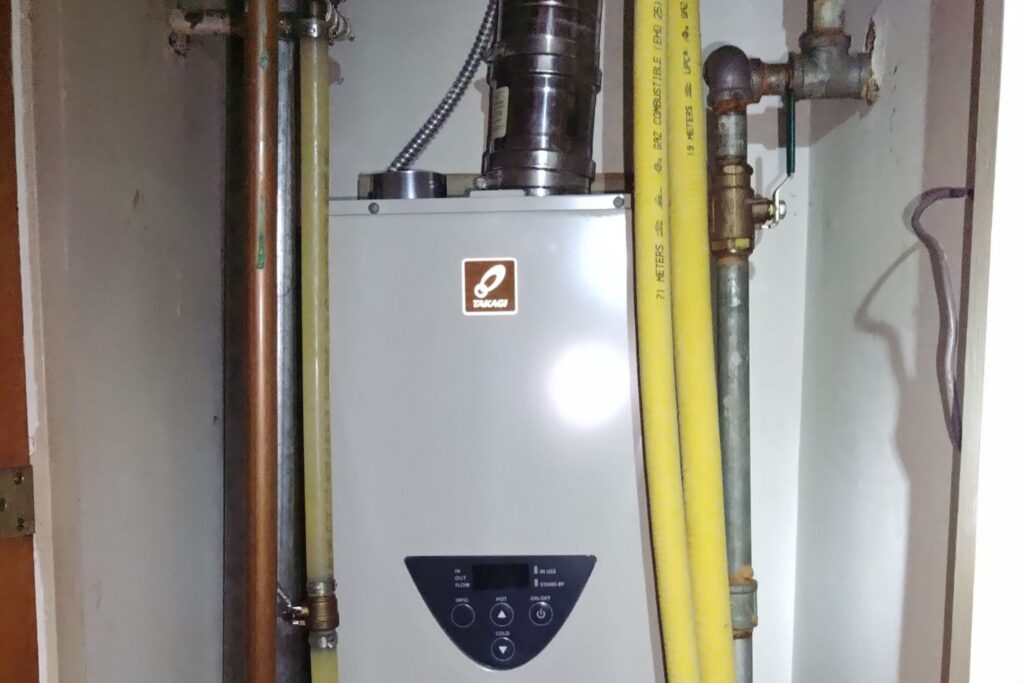
Your Takagi tankless is showing a code and there’s no hot water. Before you do anything else, write down the code and the model number off the rating plate on the side of the heater.
This post goes through the codes in Takagi’s manuals for its current tankless models: what each one means, what you can check yourself, and which ones need a licensed plumber. Some of them turn out to be something you can check yourself in five minutes without paying us a dime.
Read This First
This is a guide to Takagi’s manuals, not a replacement for them. Codes and steps can differ from one model to the next, so if anything here disagrees with the manual for your unit, go with the manual.
Takagi draws its own line. Its manual says installation and service must be done by a qualified installer, service agency or the gas supplier, and its FAQ says the heater must be serviced by a licensed plumber, a licensed gas fitter or a professional service technician. Its manuals also recommend a check once a year or as necessary by a licensed technician, with any repairs done by one, and its website says internal troubleshooting is for professional service providers. We hold to that line all the way through this post.
If you smell gas, leave first, then call ONG at 800-458-4251. Takagi’s manual adds: don’t try to light any appliance, don’t touch an electric switch, and don’t use a phone in the building. Call from a neighbor’s phone.
If any part of the heater has been under water, don’t use it. Most of Takagi’s manuals say a flooded heater has to be replaced, not repaired. The T-KJr2U, T-K4U and T-D2U manual says to have it inspected and the damaged parts replaced.
Find Your Model and Write Down the Code
The model is on the rating plate on the side of the heater, or the front panel on some models. When you call, Takagi asks for the product name and the serial number off that plate.
The codes in this post come from the manuals Takagi lists for its current models:
- TK-240X3, TK-340X3 and TK-540X3, the condensing models with Takagi’s X3 scale prevention.
- TK-540P, a condensing model with a built in recirculation pump.
- T-H3J, T-H3S, T-H3 and T-H3M, also condensing.
- TK-110C, TK-310C and TK-510C, indoor models with a concentric vent.
- T-KJr2, T-K4 and T-D2, and their T-KJr2U, T-K4U and T-D2U versions.
Takagi’s codes are three digits, like 111, and they show on the built in controller and the remote. On the T-KJr2 and T-K4, a remote may show only the first two digits, like 32 for 321.
We didn’t find an owner’s manual on Takagi’s site for its TK-110U, TK-310U and TK-510U, so if yours is one of those, call Takagi or us before you go by this chart.
Check the Basics First
Takagi’s troubleshooting chart starts with the basics. When a faucet gets no hot water, it asks:
- Does the heater have 120 volt power, and if you use a remote, is its power button on?
- Is the gas supply valve fully open?
- Is the water supply valve fully open?
- Is the filter on the cold water inlet clean? More on that filter below.
- Is the faucet open far enough to pull at least 0.5 gallons a minute through the heater?
- Is the heater frozen?
- On propane, is there enough gas in the tank?
- Are the hot and cold lines reversed or crossed? That’s an installer’s problem.
If a code keeps coming back after the basics check out, find it in the chart below. A unit that keeps throwing codes is often an install problem: an undersized gas line, the wrong vent, no isolation valves.
Clearing a Code
Takagi’s manuals for most of its models say many codes clear on their own when the water flow stops, including 111 and 121. Turn off the hot faucet, then try it again. If the code comes back, write it down and call.
On the T-H3 models, some codes, like 991, are cleared at the circuit board inside the heater, and Takagi puts those steps in its service handbooks for technicians.
Takagi Error Codes
Here are the codes in the error code tables of Takagi’s manuals, in plain English. Takagi’s own table says to check its list of items and then consult the manufacturer, and most of those checks are inside the cabinet. The last column only has the ones outside it. Where it says to call, that means a licensed plumber. Takagi’s number in its manuals is 1-877-737-2840, and you can call us at (918) 800-4426.
| Code | What it means | What you can check |
|---|---|---|
| 031 | A settings switch on the circuit board is set wrong. | Call a licensed plumber. |
| 101 | A warning that the heater is headed for a 991, imperfect combustion. | Make sure nothing is blocking the air intake or the exhaust outside. Then call. |
| 111 | Ignition failure. The burner didn’t light. | Make sure the gas supply valve to the heater is fully open. On most models, Takagi says this one clears when the water flow stops, so turn the faucet off and try again. If it comes back, call. |
| 121 | Loss of flame. The flame went out. | Make sure the gas supply valve to the heater is fully open. On most models, Takagi says this one clears when the water flow stops, so turn the faucet off and try again. If it comes back, call. |
| 291 | The condensate drain is blocked, on the X3 and T-H3 models. | Check the condensate drain line, and the neutralizer if there is one, outside the heater for a clog, and make sure any level runs slope downward. Then call. |
| 311 | A temperature sensor failed: the outlet sensor on most models, the heat exchanger sensor on the 540 models and the TK-510C. | Call a licensed plumber. |
| 321 | The inlet water temperature sensor failed. | Call a licensed plumber. |
| 331 | A temperature sensor failed. Which one depends on the model. | Call a licensed plumber. |
| 341 | The exhaust temperature sensor failed, on indoor models. | Call a licensed plumber. |
| 351 | The return water temperature sensor failed, on the TK-540P. | Call a licensed plumber. |
| 391 | The air-fuel ratio rod failed. | Call a licensed plumber. |
| 441 | The flow sensor failed. On most models it shows only on linked heaters. | Takagi’s T-H3 manual says to make sure the hot and cold shutoff valves at the heater are open and to check the inlet filter, covered below. Then call. |
| 510 | A gas valve problem. Takagi’s T-KJr2, T-K4 and T-D2 manuals, U versions included, swap the meanings of 510 and 551. | Call a licensed plumber. |
| 551 | A gas valve problem. | Call a licensed plumber. |
| 611 | The fan motor failed. | Call a licensed plumber. |
| 631 | The built in recirculation pump failed, on the TK-540P. Takagi’s checks include whether the water in the pump froze. | Call a licensed plumber. |
| 651 | The flow adjustment valve failed, on linked heaters. | Call a licensed plumber. |
| 661 | The bypass valve failed, on some models. Takagi’s checks include scale locking up the valve’s motor. | Call a licensed plumber. |
| 701 | A circuit board problem. | Call a licensed plumber. |
| 711 | A gas valve circuit problem. The older U model manual calls it a circuit board fault. | Call a licensed plumber. |
| 721 | The heater saw a flame that shouldn’t be there. | Call a licensed plumber. |
| 741 | The heater lost contact with its remote. | Make sure the heater has power. Then call. |
| 751 | The heater lost contact with its built in controller, on indoor models. | Make sure the heater has power. Then call. |
| 761 | Linked heaters lost contact with each other. | Make sure all the linked heaters have power. Then call. |
| 941 | The exhaust is too hot, on indoor models. | If you have a recirculation system, check whether the temperature is set above 140 degrees. Takagi lists that on some models. Then call. |
| 991 | Imperfect combustion. | Make sure nothing is blocking the air intake or the exhaust outside. Then call. Takagi also checks the gas type and the altitude setting, which are jobs for a plumber. |
Codes You Can Usually Check Yourself
It’s a spectrum. A one time ignition lockout, a scale related flow code or a fouled vent termination outside are a reset, a descaling or a cleaning.
111 and 121: Ignition and Flame
Start with the gas. Takagi’s troubleshooting chart asks whether the gas supply valve is fully open and, on propane, whether there’s gas in the tank. On most models both codes clear when the water flow stops, so turn the faucet off and try again.
If it keeps coming back, call us. A whole house tankless runs 150,000 to 199,000 BTU, so the half inch line that fed your old tank almost never covers it, and an undersized gas line is one of the install problems behind a unit that keeps throwing codes. We never want you doing gas yourself.
Takagi also says these heaters have no pilot, so don’t try to light the burner by hand. Turn the gas shutoff valve by hand only, never with tools, and if it won’t turn, Takagi says not to force it and to call a qualified service technician.
101 and 991: Air and Exhaust
101 is the warning and 991 is the code it warns about. For both, one of Takagi’s checks is whether anything is blocking the air intake or the exhaust. A tankless has its own vent and a matching air intake, usually PVC or stainless out a side wall. Go look at where they come out.
Takagi’s maintenance list also says to keep the area around the heater, the vent termination and the air intake free of dust and debris, and to check the termination screen, if there is one, for anything blocking it, snow and ice included.
Its other checks include the gas type, the altitude setting, the distance between the intake and exhaust terminals and dirt in the burner and fan, and those are for a plumber.
291: The Condensate Drain
Condensing models drain water through a condensate line. For 291, Takagi says to clear any blockage in the drain line and the neutralizer, if there is one, and to make sure any level runs slope downward with no sags. The rest of its list is inside the heater. If the line is clear and the code comes back, call.
741, 751 and 761: Lost Contact
These mean the heater lost contact with its remote, its built in controller or the other heaters it’s linked to. Takagi’s first check you can do is whether the heater, or every linked heater, has power. The rest of its list includes the remote’s model type and the wiring, and that’s a call.
Codes That Need a Plumber
For the rest, Takagi’s checks mostly go inside the cabinet: the high limit switch, wiring, the circuit board, the temperature sensors, the gas valves, the fan and the water valves. Takagi’s own site says internal troubleshooting is for professional service providers. That’s the settings switch code (031), the temperature sensors (311, 321, 331, 341 and 351), the air-fuel ratio rod (391), the gas valves (510, 551 and 711), the fan (611), the pump (631), the water valves (651 and 661), the circuit board (701) and a flame where there shouldn’t be one (721).
When you call Takagi, it asks for the product name and serial number off the rating plate. Have those and the code ready for us too.
Heat exchanger, gas valve, control board and overheat faults are the other end of the spectrum, and on our own jobs those have run fifteen hundred to three thousand.
Takagi’s Maintenance List
Takagi’s manuals list the maintenance its heaters need without saying who does each item. We recommend a plumber for all of it. If you’re handy, these are the items you can see to from outside the heater, and if you do them yourself, follow your manual exactly. The risk is yours:
- Keep the area around the heater, the vent termination and the air intake free of dust and debris, and keep anything that burns away from it.
- Make sure the openings for combustion and ventilation air aren’t blocked.
- Check the termination screen, if there is one, for blockages, snow and ice included.
- Check that the condensate drain system drains properly.
- Clean the cold water inlet filter. More on that below.
Takagi also says the venting should be checked once a year for leaks, corrosion, blockages or damage, and the burner checked once a year by a licensed technician.
On the pressure relief valve, Takagi’s TK-X3 and T-H3 manuals say to operate it now and then to make sure it works, after checking that it will discharge somewhere safe, and to call a service technician if it lets water out on its own. Its other manuals don’t ask owners to operate it, and the T-KJr2U, T-K4U and T-D2U manual says not to touch it, so on those, leave it to us.
The Water Filter
The water filter sits inside the cold water inlet, and when it clogs, Takagi says water won’t reach the heater properly. We recommend having a plumber clean it. Takagi’s manuals include the steps, so if you’re handy, follow your manual’s steps exactly. On the TK-X3 they go: close the gas shutoff valve, turn the power off, back on, wait 30 seconds and turn it off again, close the inlet water valve, and open all the hot faucets in the house until the water stops, then close them. With a bucket ready, take out the large drain plug, which holds the filter, let the heater drain, clean the filter with a small brush, put it back, and screw the plug in by hand. If you have isolation valves, or your model has a second drain plug, your manual’s steps are different.
Takagi’s own warnings in those steps: don’t lose the o-ring on the drain plug, and tighten the plug by hand only. If you do it yourself, the risk is yours.
Scale and Tulsa Water
Takagi’s manuals for most models say water hardness must not go over 7 grains per gallon, 120 ppm, in a single family home, and that hard water scaling has to be avoided or controlled with proper water treatment.
The X3 models are the exception. They have Takagi’s scale prevention built in, and its brochure says they don’t need annual descaling.
Takagi’s FAQ recommends a water softener or a water treatment device ahead of the heater in hard water areas, says very hard water may call for flushing the heat exchanger by a plumber now and then, and says keeping the temperature low also helps.
In Tulsa that matters. Our water is hard, and the scale it leaves narrows the heat exchanger until you get flow codes and an early failure. On a heater without built in scale prevention, descaling is maintenance you have to keep up with, and we do it in house.
Winter: Keep the Power On
Takagi’s heaters have heating blocks that turn on when the air around them drops below 36.5 degrees, and the TK-540X3 and T-H3 indoor models also fire the burner for a few seconds to protect the heat exchanger. Takagi says they only work with power to the heater.
If the power goes out while it’s freezing, Takagi recommends draining the heater and disconnecting the power. Do the same if you won’t use it for a long time. The draining steps are in the manual. If you aren’t comfortable with them, call us.
That protection only covers the pipes inside the heater. Takagi says to protect and insulate the hot and cold pipes outside it. In areas that freeze, it also highly recommends an indoor model installed indoors.
Do’s and Don’ts
Do
- Write down the code and the model and serial number off the rating plate.
- Check the basics first: power, the gas and water valves, and the faucet open far enough.
- Keep the vent and air intake outside clear, snow and ice included.
- Keep the inlet water filter clean. We recommend a plumber, though Takagi’s manual includes the steps.
- Have it checked once a year by a licensed technician. Takagi recommends it.
- On anything but an X3, keep up with flushing. In Tulsa it isn’t a suggestion.
- Keep the power on all winter.
Don’t
- Don’t keep resetting a code that keeps coming back.
- Don’t open the heater or work on the wiring. Takagi says internal troubleshooting is for professionals.
- Don’t try to light the burner by hand.
- Don’t use tools on the gas shutoff valve.
- Don’t use it if any part has been under water. Most of Takagi’s manuals say it has to be replaced.
- Don’t keep gasoline or anything else that burns near it.
- Other than turning the gas shutoff valve, don’t touch the gas. Call a licensed plumber.
What It Costs
On our price list, tankless water heater repair runs $650 to $1,225, and tankless descaling runs $425 to $850.
Tell us the code and the model number when you book.
Takagi’s Manuals and Support
Everything in the chart comes from Takagi’s own documents, and these are the ones worth keeping:
- Takagi TK-X3 installation manual and owner’s guide: for the TK-240X3, TK-340X3 and TK-540X3. Maintenance starts on page 49, and the error codes are on pages 53 to 55.
- Takagi T-H3 installation manual and owner’s guide: for the T-H3J, T-H3S, T-H3 and T-H3M. The error codes start on page 58.
- Takagi’s manuals page, for the manual that matches your model.
- Takagi’s FAQ, for its advice on hard water.
- Takagi: 1-877-737-2840, the number in its manuals. Its website also lists 1-888-882-5244.
- ONG, if you smell gas: 800-458-4251.
We checked this post against the manuals on Takagi’s site in November 2026, so if yours is a different version, go with yours.
Call Us With the Code
We service every brand, and around Tulsa we see Navien, Rinnai, Rheem, Noritz and A.O. Smith most. Our error code guides for Navien, Rinnai, A.O. Smith, Rheem and Noritz cover the others, and our tankless error codes page shows which codes mean the same thing across brands.
Call us at (918) 800-4426 with the code and the model number. Our tankless water heater repair page has more on what we do.