
Putting in a fence, a sprinkler system, a patio, or a tree this fall? Call 811 before anybody digs. It’s free, and state law requires it. But 811 doesn’t mark everything in your yard, and what it skips are the lines you own. Here’s what’s still down there, and how to get it found first.
Call 811 Every Time
811 is Oklahoma One Call. It’s free, state law requires it two working days before you dig, and you should do it every time.
Just know what it covers. 811 marks the utility-owned lines, and it stops at the meter.
What 811 Doesn’t Mark
Everything past the meter is yours: the water line, the sprinklers, the gas out to the shop, the sewer. Those get located separately.
Your water line
You own it from the outlet side of the meter to the house. The city owns the main in the street and the meter itself. Everything past it is yours to maintain and replace, which is news to a lot of homeowners the first time a service line fails.
Your gas line
Oklahoma Natural Gas maintains the lines that bring gas to the meter for your house. Past the meter, the piping is yours, both inside the house and running out to another building or an outdoor appliance, like a gas grill or a pool heater. Our post on gas piping covers where ONG stops and you start.
Your sewer
You’re responsible for the drain line from your home to the public sewer. Sometimes a section of it runs under a neighbor’s yard or a street.
Your gutter drains
Most underground gutter drains empty into the street, driveway, or sidewalk, but they can also connect with storm drains. If you don’t know where yours comes out, we can trace it.
Why the Locate Comes First
Getting your lines located is the cheap part of the project. Here’s where it pays off.
Sprinkler systems
Irrigation crews tie in near the meter and trench across the front yard, which is exactly where your service line already runs.
Patios
Pouring a patio over your service line costs you later, because the repair has to come up through concrete instead of grass.
Fences
Your fence crew needs to see the line before the post holes go in. We mark it on every locate, so they can.
Trees
Know where the sewer runs before you plant. Roots don’t break into a healthy pipe, they follow moisture out of a weeping joint, and Tulsa’s older neighborhoods are full of clay tile and cast iron. Our post on sewer line repair covers what happens once they’re in.
How We Find a Buried Line
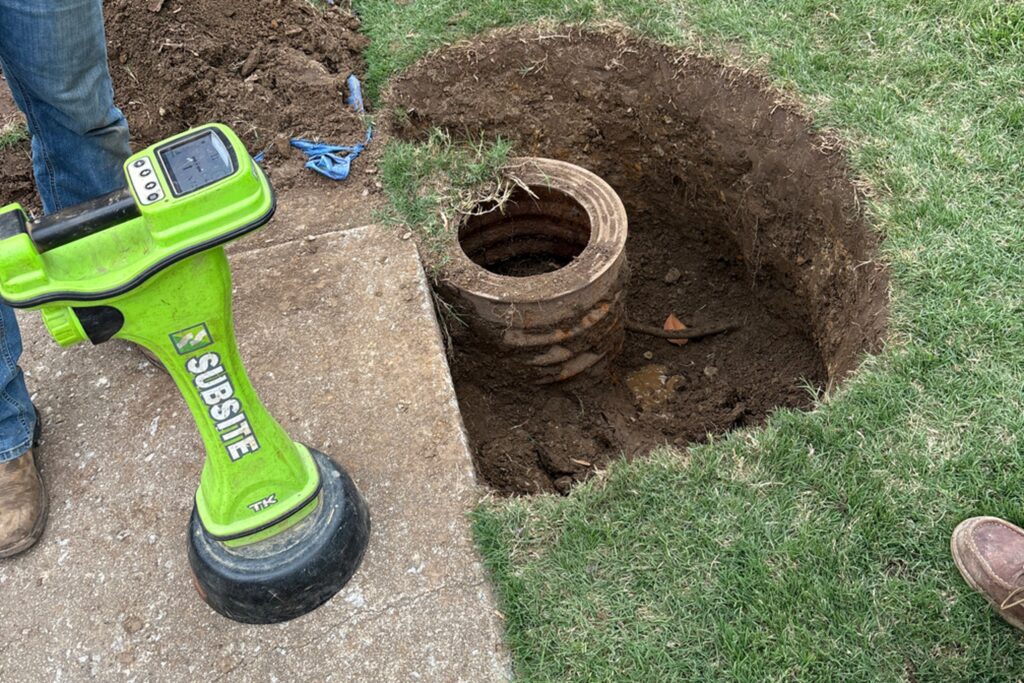
It depends what the line is made of. On copper or galvanized, we clip a radio detection transmitter to the metal at the meter and walk the yard with a receiver, mapping the route and depth.
PEX, poly, and PVC carry no signal, so we energize the tracer wire if there is one, and work from the two known ends if there isn’t. Older Tulsa homes are still on galvanized, which for once makes them the easy ones.
Drains all lead to one main pipe, your building sewer. Depending on the material, we either track the pipe itself with a radio detection tool or feed a locating sonde through it to trace its path, often as part of a drain camera inspection.
Under a slab, we run a line down the drain with a transmitter on the end and map its path. A lot of Tulsa homes sit on slab, so it’s worth having that mapped before anybody breaks concrete.
How We Mark It
On every locate, and you don’t have to ask. We paint and flag the route in standard utility colors, blue for water and green for sewer.
Paint doesn’t survive a rain and a mow, so we also write the depth down, measure off the meter box, and send you photos.
If You Hit a Line
Get clear of it first, then call.
If it’s gas, leave the area and call Oklahoma Natural Gas at 800-458-4251 once you’re out. That’s ONG’s own instruction, and it holds whether you smell anything or not. Don’t crimp or cap it yourself.
If it’s water, shut it off at the meter if you can safely reach the valve, then call us at (918) 800-4426.
Already Have a Wet Spot in the Yard?
A pinhole in the buried service line shows up as a soft patch that stays wet, or one strip of grass thriving through an August dry spell.
Water follows the path of least resistance, so the wet spot is usually nowhere near the break, which is why we trace end to end before we dig. Our post on water leak detection walks through how we find it.
What a Locate Costs
It depends on the length, the material, and access to both ends, so we’ll price it before we start work, and there aren’t surprises on the bill.
Meet us at the start to point out the meter and where you’re digging.
Need a Line Located Before You Dig?
Call us at (918) 800-4426. Tell us what’s going in, where it’s going, and when the digging starts.
Our water line location page has more answers about buried lines.