
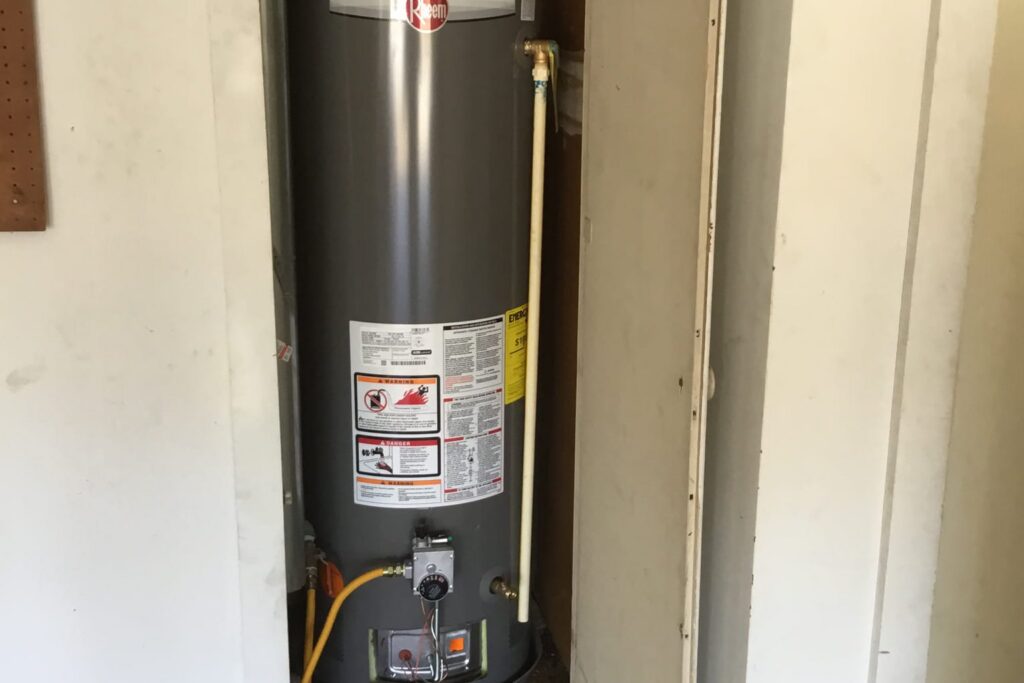
Your Rheem gas water heater quit making hot water, and the light on the gas control is blinking. Count the blinks, note whether they’re blue or red, and write down the model and serial number off the rating plate.
This post goes through what that light means on Rheem’s tank water heaters: which patterns are normal, which ones need a licensed plumber, and what Rheem says you can check yourself. If yours is a Rheem tankless, our Rheem tankless error codes post covers that one.
Read This First
This is a guide to Rheem’s manuals, not a replacement for them. Codes and steps can differ from one model to the next, so if anything here disagrees with the manual for your heater, go with the manual.
Rheem splits the work. Its manual says installation and service must be done by a qualified installer, a service agency or the gas supplier, and not to attempt repair of gas piping, the gas control, burners, vent connectors or other safety devices. It suggests a routine maintenance program for the owner, with periodic inspections by service personnel qualified in gas appliance repair. And when your heater needs service, Rheem says to contact your installer or plumbing contractor first.
Our line: we recommend a plumber. Where Rheem’s manual gives you a job, a handy homeowner can do it if they follow the manual exactly, and the risk is theirs.
If you smell gas, leave first, then call ONG at 800-458-4251. Rheem’s manual adds: don’t try to light any appliance, don’t touch any electrical switch, don’t use any phone in your building, and don’t go back in until the gas company or the fire department says so.
If any part of the heater has been under water, don’t use it. Rheem says a flooded water heater must be replaced, not repaired.
If there’s water on the floor, shut the valve on the cold line into the top of the tank, kill the gas or the breaker, and call us. Our post on a leaking water heater covers where the water is coming from.
One thing that isn’t a leak: Rheem says a tank can sweat when it’s first filled, or during a heavy draw when the incoming water is very cold, and drops on the burner can sizzle or ping. It goes away once the water heats up. If it doesn’t, Rheem says to check the piping and fittings for leaks.
Which Control Do You Have?
Rheem’s standard gas models, the ones that aren’t Ultra Low NOx, split two ways. Its Performance and Performance Plus atmospheric models have a gas control with a STATUS light that blinks blue when things are normal and red when they’re not. Its Professional Classic and Professional Classic Plus atmospheric models, its direct vent models and its manufactured housing models have a gas control with no status light, so none of the charts below apply to them.
Most of Rheem’s Ultra Low NOx models, Professional Classic included, have the blue and red light too, with two extra codes. Some older Ultra Low NOx models show the same counts without the colors or the two extra codes.
Its power vent models have a different control with its own light and chart, further down.
Its powered damper, induced draft and power direct vent models, its Maximus condensing models, its electric models with electronic controls and its ProTerra heat pumps each have their own charts. Go by the manual for those.
Find Your Model and How Old It Is
The model and serial number are on the rating plate on the heater’s jacket. Rheem’s bulletin on reading serial numbers, which covers its Ruud and Richmond brands too, says the newer labels start with a plant letter, then two digits for the week and two for the year. In its example, M141209135 was made at the plant coded M in week 14 of 2012. On older labels, the first four digits are the month and the year.
How to Read the Light
On the Performance and Ultra Low NOx models, one blue blink every three seconds is normal: the pilot is lit. Red blinks mean a problem. Count them between pauses, and look the number up in the chart below. The pilot has to be lit to show a code. If the knob is turned to OFF while the pilot is lit, the light stays on for a moment and turns from blue to red.
Rheem Status Light Chart
Here are the patterns from the status light chart in Rheem’s manuals for those models, in plain English. Where it says to call, that means a licensed plumber.
| Light | What it means | What you can do |
|---|---|---|
| No light | The gas control is off, the pilot is out, or the thermopile isn’t making enough power. | See Relighting the Pilot, below. |
| Solid light | The pilot just went out and the thermopile is cooling down, or the knob was just turned to OFF. | Wait for it to go out. Then see Relighting the Pilot, below. |
| 1 blue every 3 seconds | Normal. If the knob is still at PILOT, Rheem says to set it to the temperature you want. | Nothing, if the water is hot. |
| 2 red | Low thermopile voltage, though the pilot is lit. | Call a licensed plumber. |
| 4 red | The high water temperature limit tripped. | Turn off the gas shutoff valve to the heater and call. Rheem says to contact a qualified service technician. |
| 5 red | The water temperature sensor failed. | Call a licensed plumber. |
| 7 red | The gas control failed. | Call a licensed plumber. |
| 8 red | A false pilot flame signal. | Call a licensed plumber. |
| 9 red | On Ultra Low NOx models, the chamber sensor failed. | Call a licensed plumber. |
| 10 red | On Ultra Low NOx models, a chamber temperature shutdown. | Call a licensed plumber. |
Rheem’s chart has no 3 or 6. If you’re counting one of those, count again, and if it holds, call.
Power Vent Models
On Rheem’s current power vents with the Honeywell gas control, a short flash every four seconds means standby, and a light that alternates bright and dim means it’s heating. Careful: here, one flash every three seconds is a fault, not normal like on the pilot models. Rheem says the control tries to light the burner three times before it locks out and the light warns you.
Some codes come in two parts. In the chart, 6, then 1 means six flashes, then one.
| Flashes | What it means | What you can do |
|---|---|---|
| 1 every 3 seconds | Low flame signal. | Call a licensed plumber. |
| 2 | The pressure switch failed closed. | Call a licensed plumber. |
| 3 | The pressure switch or the blower thermal switch failed open. | Rheem’s guide lists a blocked vent. Look at the vent where it leaves the house for anything blocking it. Then call. |
| 4 | The temperature cutoff tripped. | Turn off the gas shutoff valve to the heater and call. |
| 5 | A flame out of sequence. | Call a licensed plumber. |
| 6, then 1 | Lockout: the burner failed to light. | Make sure the gas shutoff valve to the heater is open. Then call. |
| 6, then 2 | Lockout: the pressure switch or the blower thermal switch opened. | Rheem’s guide lists a blocked vent. Look at the vent where it leaves the house for anything blocking it. Then call. |
| 6, then 3 | Lockout: the flame was lost. | Make sure the air openings around the bottom of the heater aren’t blocked. Then call. |
| 6, then 4 | Lockout: a flame was sensed out of sequence. | Call a licensed plumber. |
| 6, then 5 | Lockout: failed ignition attempts. | Make sure the gas shutoff valve to the heater is open. Then call. |
| 7 | Lockout: the flammable vapor sensor tripped. | If you smell gas, leave first. Otherwise, Rheem says to clear away anything hazardous, air the area out, leave the heater and its ON/OFF switch alone, and contact a qualified service technician. |
| 8, then 1 | A flammable vapor sensor fault. | Call a licensed plumber. |
| 8, then 2 | A temperature sensor fault. | Call a licensed plumber. |
| 8, then 3 | An electronics fault. | Call a licensed plumber. |
| 8, then 4 | A gas control fault. | Call a licensed plumber. |
Older Rheem power vents used other controls, and the same flash count can mean something different on them. Some models also have a display. Go by the manual for yours.
Relighting the Pilot
On Rheem’s standing pilot models, the lighting instructions are printed on the heater, and its maintenance list has the owner check the pilot and relight it if needed. Its power vents light their own pilot, and Rheem says not to try to light those by hand.
We recommend a plumber. If you relight a standing pilot yourself, follow the label exactly. The risk is yours.
Rheem’s own limits: the pilot is lit by the spark button, so don’t open the inner door and light it by hand. If you smell gas, stop. Use only your hand on the knob, never tools. If the knob won’t turn by hand, Rheem says not to try to fix it and to call a qualified service technician. If it won’t stay lit after several tries, turn the knob to OFF and call. If the knob doesn’t pop back out when you let go, stop and call right away.
Rheem names a few causes of a pilot that keeps going out, including a hot attic with poor ventilation in summer and heavy condensation. Its heaters also have a combustion shutoff device that shuts them down if the air openings are blocked or flammable vapors are present, and Rheem says to contact a qualified service technician if that happens.
Codes That Need a Plumber
Most of the rest come down to a part: the thermopile, a sensor, the gas control, or on a power vent, the pressure switch, the blower or the pilot assembly. For 4, 5, 7, 8, 9 and 10 red blinks, Rheem’s own chart says to contact a qualified service technician.
When you call, have the blink count and color, the model and the serial number ready.
Repair It or Replace It?
Age decides this more than the symptom does. Early on, thermocouples, gas valves, elements and thermostats are normal wear parts worth fixing. Past 12 years we start recommending replacement, and a tank that’s leaking isn’t repairable at any price by anybody.
The serial number tells you how old yours is. Our post on tank water heater replacement covers what comes next.
Rheem’s Maintenance List
Rheem suggests the owner follow a routine maintenance program. We recommend a plumber for all of it. If you’re handy, follow your manual exactly, and the risk is yours. Here’s what’s on it:
- Drain a few quarts of water from the tank every month to clean out deposits. Rheem warns the water can be hot enough to scald.
- Once a year, work the relief valve’s lever to make sure it moves freely, and let a few quarts run out the discharge pipe into a drain. Rheem warns the water may be hot enough to scald.
- Once a year, take the anode rod out and inspect it, with the cold water supply turned off first. Rheem says to replace it when more than 6 inches of core wire shows.
- Inspect the vent system and the chimney at least once a year.
- Look at the pilot and main burners once a year. Rheem says cleaning the burner is only for qualified service personnel.
- Keep the combustion air openings around the bottom of the heater clear, with at least an inch of room.
Rheem’s draining section says to shut off the gas at the manual shut-off valve before draining water, so the pilot will need relighting afterward. Follow both sets of steps exactly.
Rheem also wants the gas control, the burner, the relief valve and the venting inspected now and then by someone qualified in gas appliance repair. That part is ours.
Rumbling, Popping and Tulsa Water
If the heater rumbles and pops when it heats up, that’s sediment, and Tulsa’s hard water makes plenty of it. Minerals crust across the bottom, and water trapped underneath flashes to steam, so it sounds like gravel in there. Rheem’s manual suggests draining a few quarts every month, and its bulletin on flushing, a bigger job, says homeowners should flush the tank at least every six months, and that some areas with hard water may need it more often. Let us do the first one.
The Relief Valve and Expansion
If water drips out of the pipe on the side of the tank, that’s the temperature and pressure relief line, and the valve is doing its job. Rheem’s bulletin on these valves says a discharge may mean an unsafe temperature or pressure condition, and to contact a licensed plumber right away. Its manual says a valve that discharges now and then may be thermal expansion in a closed water system, calls that an unacceptable condition that has to be corrected, says replacing the valve won’t fix it, and says never to plug its outlet. A steady drip means high pressure, a waterlogged expansion tank, or a thermostat set too hot. Never cap that pipe.
Rheem’s suggested fix for thermal expansion is an expansion tank in the cold line. A pressure reducing valve or check valve on your main makes a closed system, and heated water has nowhere to expand. Without an expansion tank you get a dripping T and P valve and banging pipes. The bladder gives up around 5 to 10 years, so we check it on every water heater visit.
Do’s and Don’ts
Do
- Count the blinks, note the color, and write down the model and serial number off the rating plate.
- Keep the air openings around the bottom of the heater clear.
- Keep up with draining. Rheem says a few quarts a month.
- Keep gasoline and anything else that burns away from the heater.
Don’t
- Don’t ignore a code that keeps coming back. Call.
- Don’t try to repair the gas control, burners or gas piping. Rheem says to leave repairs to qualified service personnel.
- Don’t use it if any part has been under water.
- Don’t plug or cap the relief valve or its discharge pipe.
- Other than turning the gas shutoff valve and following the lighting label on a standing pilot model, don’t touch the gas. Call a licensed plumber.
What It Costs
On our price list, a pilot assembly replacement runs $350 to $675, replacing a gas control valve runs $550 to $1,050, a general water heater repair runs $450 to $900, and our flush and tune-up runs $250 to $500.
Tell us how many times the light blinks, what color, and the model number when you book.
Rheem’s Manuals and Support
Everything in the charts comes from Rheem’s own documents, and these are the ones worth keeping:
- Rheem’s Performance gas water heater manual: the lighting label is on page 17, maintenance on pages 20 and 21, and the status light chart on page 24.
- Rheem’s power vent manual: the status light chart is on page 37.
- Rheem’s technical bulletins, including the ones on serial numbers, flushing and pilot outages.
- Rheem: 1-866-279-4566, the number in its manual.
- ONG, if you smell gas: 800-458-4251.
We checked this post against the manuals on Rheem’s site in November 2026, so if yours is a different version, go with yours.
Call Us With the Blink Count
We service every brand, and Rheem is one of the three we install, along with A.O. Smith and Bradford White. Our Bradford White and A.O. Smith guides cover those brands, and we have one for State too. Our water heater blinking light page compares all four. Our tankless error codes page covers the tankless side.
Call us at (918) 800-4426 with the blink count and the model number. Our water heater repair page has more on what we do.