
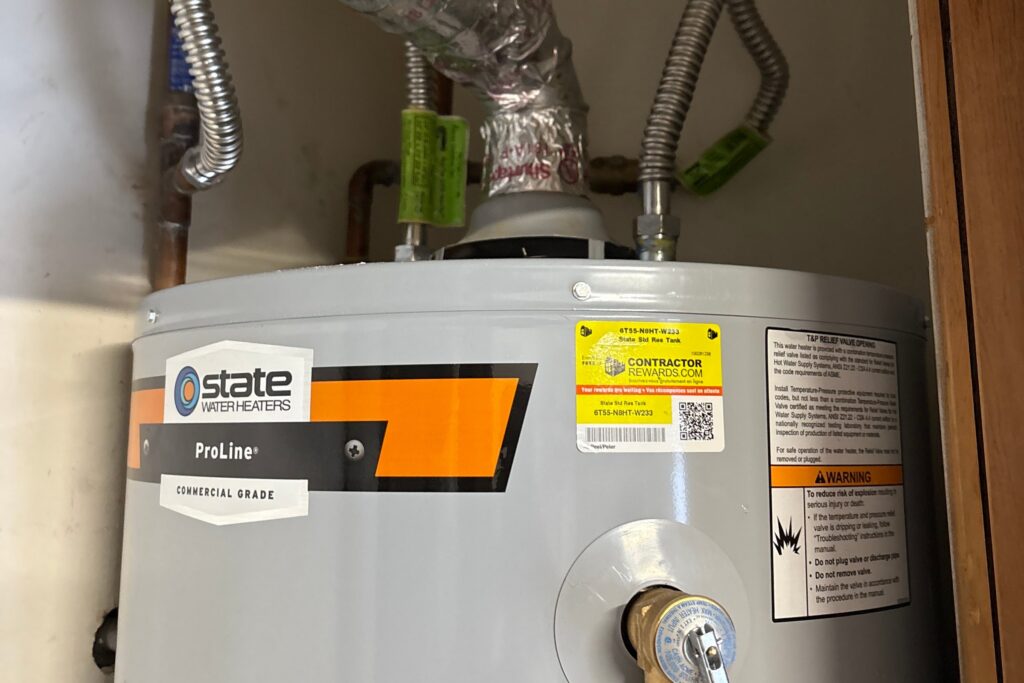
Your State gas water heater quit making hot water, and the light on the gas control is blinking. Count the flashes, and write down the model and serial number off the rating plate.
This post goes through what that light means on State’s tank water heaters: which patterns are normal, which ones need a licensed plumber, and what State says you can check yourself.
Read This First
This is a guide to State’s manuals, not a replacement for them. Codes and steps can differ from one model to the next, so if anything here disagrees with the manual for your heater, go with the manual.
State’s own website says State is a division of the A.O. Smith Corporation, and many of the manuals State links are the same documents A.O. Smith links for its own heaters. So if you’ve read our A.O. Smith guide, a lot of this will look familiar.
State’s manuals say installation and service must be done by a qualified installer, a service agency or the gas supplier, and one of them lists licensed plumbers as an example of a qualified technician. They also give you the steps for lighting the pilot and for routine maintenance, and say that if you can’t do the maintenance yourself, to contact a qualified person. State’s troubleshooting guide for power vent models is written for a qualified service agent.
Our line: we recommend a plumber. Where State’s manual gives you a job, a handy homeowner can do it if they follow the manual exactly, and the risk is theirs.
If you smell gas, leave first, then call ONG at 800-458-4251. State’s manual adds: don’t try to light any appliance, don’t touch any electrical switch, and don’t use any phone in your building. Call from a neighbor’s phone.
If any part of the heater has been under water, don’t use it. State’s manual says a flooded water heater has to be replaced, not repaired.
If there’s water on the floor, shut the valve on the cold line into the top of the tank, kill the gas or the breaker, and call us. Our post on a leaking water heater covers where the water is coming from.
One thing that isn’t a leak: State says a cold tank often sweats inside when the heater is first lit. You might hear drips or a sizzle, or see a small puddle, and it stops once the water is up to temperature.
Which Control Do You Have?
Most of State’s standard gas models, like the ProLine and ProLine Master, have a standing pilot and a gas control with a status light. State’s spec sheet for its ProLine atmospheric models says the gas control has an LED status indicator, except on its 60,000 BTU models.
One wrinkle: on State’s pages for its standard ProLine and ProLine Master models, and most of its ultra low NOx models, the only manual linked is an older one written for heaters with a thermocouple. It has no status light chart, and State doesn’t say which chart fits. Ours comes from the manuals State links for its other standing pilot models, and every one of those charts gives each flash count the same meaning.
Plenty of older State heaters have a mechanical gas control with no status light. None of the charts below apply to those.
State’s power vent and power direct vent models have no pilot. They light the burner with a hot surface igniter, have an ON/OFF switch on the gas control, and flash their own codes. Their chart is further down.
Its flue damper models, its Premier and Polaris high efficiency models, its electric models with an electronic thermostat or a display, and its heat pumps each have their own charts. Go by the manual for those.
Find Your Model
The model and serial number are on the rating plate, next to the gas control. If your rating plate has a QR code, State says scanning it shows the model and serial number, with a link to the manual for your heater.
How to Read the Light on Pilot Models
One flash every three seconds is normal. It means the pilot is lit and the gas control hasn’t found a problem. If you’re getting that and still have no hot water, State’s first check is that the gas control knob is set to HOT.
A light that stays on solid means the pilot was lit and went out, or the heater was just turned off. No light at all means the pilot is out.
State Status Light Chart
Here are the patterns from the status light charts in State’s manuals for its standing pilot models, in plain English. Where it says to call, that means a licensed plumber.
| Flashes | What it means | What you can do |
|---|---|---|
| No light | The pilot is out. | See Relighting the Pilot, below. |
| Solid light | The pilot was lit but is now off, and the thermopile is cooling down. Some models show it red. | Wait 10 minutes for the light to go out. Then see Relighting the Pilot, below. |
| 1 every 3 seconds | Normal. The pilot is lit, and the control hasn’t found a problem. | Nothing. If the water is still cold, see How to Read the Light, above. |
| 2 | Not enough power from the thermopile to the gas control. | Call a licensed plumber. |
| 4 | The water got too hot and tripped the overheat sensor. The pilot goes out too, so this code only shows right after the pilot is relit. | Turn off the gas shutoff valve to the heater and call. State says the gas control valve has to be replaced. |
| 5 | A temperature sensor failed. | Call a licensed plumber. |
| 7 | The gas control valve failed. | Turn off the gas shutoff valve to the heater and call. State says the gas control valve has to be replaced. |
| 8 | The knob was turned off, but the thermopile kept making power, or the pilot valve is stuck open and the pilot is still burning. | Call. If the pilot is still burning with the knob off, State says to turn the main gas supply off. |
| 9 | On ultra low NOx models, the combustion chamber temperature sensor circuit is open or shorted. | Call. State says replacing that sensor is a job for a qualified person. |
| 10 | On ultra low NOx models, lint, dust or oil was detected in the combustion chamber. | Call a licensed plumber. |
There’s no 3 or 6 flash code on these charts. If you’re counting one of those, count again, and if it holds, call.
Power Vent Models
On these models, a short flash every four seconds means the heater is idle, and a light that alternates bright and dim means it’s heating. Some codes come in two parts: a group of flashes, a one second pause, a second group, then the three second pause. So 6, then 1 is six flashes, a short pause, then one.
| Flashes | What it means | What you can do |
|---|---|---|
| 1 | Low flame signal. The heater keeps running. | If it keeps coming back, call. |
| 2 | The pressure switch failed closed. | Call a licensed plumber. |
| 3 | The pressure switch failed open. | Call a licensed plumber. |
| 4 | The tank went over its temperature limit, and the control locked out. | Turn off the gas shutoff valve to the heater and call. State says to do both. |
| 5 | The control saw a flame when it shouldn’t have. | Call a licensed plumber. |
| 6, then 1 | A soft lockout: the burner didn’t light. | If it’s still flashing after 20 minutes, or keeps coming back, call. |
| 6, then 2 | A soft lockout: the pressure switch or the high limit opened. | If it’s still flashing after 20 minutes, or keeps coming back, call. |
| 6, then 3 | A soft lockout: the flame went out. | If it’s still flashing after 20 minutes, or keeps coming back, call. |
| 6, then 4 | A soft lockout: the control saw a flame when it shouldn’t have. | If it’s still flashing after 20 minutes, or keeps coming back, call. |
| 7 | The flammable vapor sensor locked the heater out. | State says to look around the heater for what set it off: gas vapors, solvents, paint and thinners, water or detergents. If you smell gas, leave first. Otherwise, call. |
| 8, then 1 | A flammable vapor sensor fault. | Call a licensed plumber. |
| 8, then 2 | A temperature sensor fault. | Call a licensed plumber. |
| 8, then 3 | An electronics fault. | Call a licensed plumber. |
| 8, then 4 | A gas valve fault. | Call a licensed plumber. |
State says the control retries a soft lockout on a timer, 20 minutes in its timing table, but it won’t run again until the problem is fixed.
State’s power direct vent models use a similar chart with a few differences: the 7 and the 8, then 1 codes don’t apply, and a light that stays on solid means a hard lockout. Go by the manual for those.
Relighting the Pilot
State puts the lighting steps in its manuals and on a label on the front of the heater.
We recommend a plumber. If you relight it yourself, follow the label and your manual exactly. The risk is yours.
State’s own limits: the status light can take up to 90 seconds to start flashing, and once it flashes once every three seconds, the pilot is lit. Wait 10 minutes between tries. If it doesn’t start flashing after three tries, turn the knob to OFF and call. Don’t try at all if you smell gas or suspect flammable vapors.
State’s label adds: work the gas control knob by hand only, never with tools. If it won’t move by hand, leave it alone and call a qualified service technician.
State also says a dirty air filter at the bottom of the heater can make the pilot go out.
Codes That Need a Plumber
Most of the rest come down to a part: the thermopile, a sensor, the gas control valve, or on a power vent, the pressure switch, the igniter, the flame sensor or the control itself. State’s own fix for 4 and 7 flashes on its pilot models is a new gas control valve. For 5 flashes, its manuals don’t agree: some say to replace the temperature sensor, and others the whole gas control valve.
One more warning from State’s manuals: when a heater that was running stops and won’t relight, blue or black discoloration on its flame arrestor points to a flammable vapor incident. If you suspect one, State says not to use the heater and to call a qualified technician. A heater that has been through one has to be replaced.
When you call, have the flash count, the model and the serial number ready.
Repair It or Replace It?
Age decides this more than the symptom does. Early on, thermocouples, gas valves, elements and thermostats are normal wear parts worth fixing. Past 12 years we start recommending replacement, and a tank that’s leaking isn’t repairable at any price by anybody.
Our post on tank water heater replacement covers what comes next.
State’s Maintenance List
State’s manuals give the homeowner a maintenance list, and State’s website says to have a licensed professional flush, inspect and maintain a gas tank water heater every year. We recommend a plumber for all of it. If you’re handy, follow your manual exactly, and the risk is yours. Here’s what’s on the list:
- Drain and flush the tank after the first six months, then once a year if there’s little sediment, or more often if there’s a lot.
- Inspect the anode rod when you drain the tank, and replace it if it’s worn out.
- Operate the temperature and pressure relief valve at least once a year, after checking that it will discharge somewhere safe. State warns that the water can be hot enough to cause severe burns.
- Have the relief valve inspected every 2 to 4 years, and check the label on the valve for its schedule. State also says a qualified person should inspect it and its discharge pipe at least every five years.
- Once a year, look over the vent, the air supply, the burner and the air filter, and vacuum the filter.
- Keep anything that burns away from the heater.
The older manual State links for its standard ProLine models says to drain and flush every six months instead.
Draining starts with turning the gas control knob to OFF and ends with relighting the pilot, so follow both sets of steps exactly.
If water won’t flow freely out of the discharge pipe when you test the relief valve, State says to turn the gas control knob to OFF and call a qualified person.
Rumbling, Popping and Tulsa Water
If the heater rumbles and pops when it heats up, that’s sediment, and Tulsa’s hard water makes plenty of it. Minerals crust across the bottom, and water trapped underneath flashes to steam, so it sounds like gravel in there. State says heavy deposits can damage the water heater, and it wants the first flush at six months to see how much builds up. Let us do the first one.
The Relief Valve and Expansion
If water drips out of the pipe on the side of the tank, that’s the temperature and pressure relief line, and the valve is doing its job. State says a small drip usually means the water pressure is too high or the house needs a thermal expansion tank. A steady drip means high pressure, a waterlogged expansion tank, or a thermostat set too hot. Never cap that pipe.
If it’s dumping a lot of very hot water, State says to shut off the gas to the heater and call. State’s website also says a leaking relief valve may point to an unsafe temperature or pressure, and to have a professional plumbing contractor look at it.
A pressure reducing valve or check valve on your main makes a closed system, and heated water has nowhere to expand. Without an expansion tank you get a dripping T and P valve and banging pipes. The bladder gives up around 5 to 10 years, so we check it on every water heater visit.
Do’s and Don’ts
Do
- Count the flashes and write down the model and serial number off the rating plate.
- Check that the knob is on HOT if the light is flashing normally and the water is cold.
- Keep the air filter at the bottom of the heater clean.
- Have the tank drained and flushed on State’s schedule.
- Keep anything that burns away from the heater.
Don’t
- Don’t ignore a code that keeps coming back. Call.
- Don’t try to light it, or press the igniter, if you smell gas or suspect flammable vapors.
- Don’t use tools on the gas control knob.
- Don’t use it if any part has been under water.
- Don’t cap or plug the relief valve or its discharge pipe.
- Other than turning the gas shutoff valve and following the steps in your manual, don’t touch the gas. Call a licensed plumber.
What It Costs
On our price list, a pilot assembly replacement runs $350 to $675, replacing a gas control valve runs $550 to $1,050, a general water heater repair runs $450 to $900, and our flush and tune-up runs $250 to $500.
Tell us how many times the light flashes and the model number when you book.
State’s Manuals and Support
Everything in the charts comes from State’s own documents, and these are the ones worth keeping:
- State’s ProLine Master ultra low NOx atmospheric manual: lighting is on page 23, troubleshooting on pages 25 to 27 with the status light chart on page 27, and maintenance on pages 28 to 30.
- State’s ProLine direct vent manual: the status light chart is on pages 27 and 28.
- State’s ProLine XE power vent manual: the codes are on page 55.
- State’s support page, for the manual that matches your model.
- State’s technical assistance line: 1-800-365-0024, the number on its ProLine spec sheet and in its older atmospheric manual.
- ONG, if you smell gas: 800-458-4251.
We checked this post against the manuals on State’s site in November 2026, so if yours is a different version, go with yours.
Call Us With the Flash Count
We service every brand, State included. The three we install are Rheem, A.O. Smith and Bradford White. Our Rheem, A.O. Smith and Bradford White guides cover those brands, and our tankless error codes page covers the tankless side. Our water heater blinking light page compares all four.
Call us at (918) 800-4426 with the flash count and the model number. Our water heater repair page has more on what we do.