
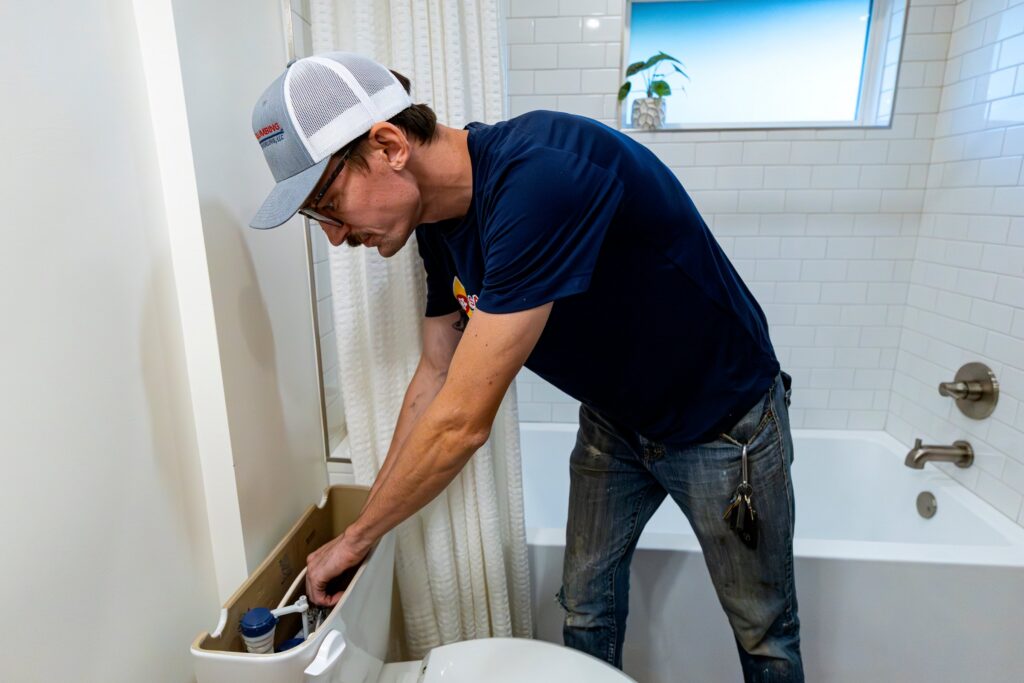
Toilet repair usually comes down to a handful of parts: the flapper, the fill valve, the wax ring, and the closet flange the toilet bolts to. Some of those you can fix yourself, and we’d rather you keep the money. Others mean pulling the toilet up off the floor. Here’s how to tell which is which, symptom by symptom.
If Water Is on the Floor Right Now
Close the stop valve behind the toilet. Every toilet has its own.
If that valve won’t turn, or the water is coming from somewhere else, shut off the main. Round handle, turn it clockwise until it stops. Straight lever, a quarter turn so it sits crossways to the pipe. In most Tulsa homes it’s near the front hose bib, in the garage, or in a utility closet. If it won’t turn with normal hand pressure, don’t force it, call us at (918) 800-4426.
A Toilet That Keeps Running
A running toilet wastes hundreds of gallons a day, and you pay for that on the sewer side too. It’s a normal day for us, and most of the time the fix is a cheap part.
Usually it’s the flapper, a cheap rubber part that hard water and chlorine eat up, and most homeowners can swap it themselves. If a new flapper doesn’t fix it, look at the fill valve, the chain, or the water level.
The quiet version
Not every running toilet makes noise. Toilets are the quietest water thief in a house, so if your water bill jumped and nothing changed, check them first. Drop food coloring in the tank, don’t flush, and look in the bowl in fifteen minutes. Color in the bowl means the flapper is passing water, and that’s a cheap fix you can do yourself.
If the toilets pass and the bill is still high, the leak is likely underground or under the slab. Our post on water leak detection walks through the meter test and what comes next.
When parts keep wearing out
If you keep replacing flappers and fill valves, check your water pressure. Anything over 80 psi is above code, and high pressure shortens the life of your faucets, supply lines, water heater, and toilet parts. We put a gauge on a hose bib to read it, and the fix is usually a pressure reducing valve. Those last 10 to 15 years and fail in either direction.
Water Around the Base, or a Toilet That Rocks
A toilet that rocks a little with water around the base is the classic wax ring call. Maybe it’s just the ring, but what’s under it decides.
A new wax ring and new closet bolts often handle it. But once the toilet is up, we’re looking at the closet flange, the fitting the toilet bolts to: cast iron rusted through, plastic cracked at the bolt slots, or sunk below a floor somebody tiled over.
Bolted to a broken flange, a toilet keeps leaking no matter how many wax rings get stacked under it. Two rings isn’t twice the seal, it’s twice the wax.
Nobody can see the flange until the toilet is up. If we find it broken, we stop, price the flange repair with you, and you’re the one who says go.
When the floor needs more than plumbing
We do plumbing and gas, nothing else. Before we start, we’ll show you what we have to open up and what’s left for a tile or flooring person to close, so you can line that up ahead of time instead of finding out while you’re standing in your bathroom.
A Clogged Toilet
Try it yourself first, we’d rather you keep the money. A toilet takes a flange plunger, the kind with the extra rubber sleeve that fits into the bowl’s outlet. Close the stop valve behind the toilet first, so a flush that doesn’t go down can’t overflow the bowl. Keep enough water over the cup so you’re pushing water, not air, and use steady strokes instead of one heroic shove.
Toilets usually clog on things that don’t break down the way toilet paper does: wipes, including the ones labeled flushable, paper towels, and cotton swabs. If it comes right back after you clear it, call us. Our post on fixing a clogged drain covers plunging and augers in more detail.
When it isn’t the toilet
If several drains are slow at once, the toilet gurgles, or water comes up in the tub or a floor drain when you flush, the toilet isn’t the problem. Those all point to the main line. Go easy on the water until it’s cleared, because a blocked main comes back up at the lowest opening in the house. Our post on drain cleaning in Tulsa covers what happens next.
Bought Your Own Toilet?
If you bought the toilet, we’ll install it. Send us the brand and a few photos ahead of time, because that lets us load the right parts before we leave the shop.
What Toilet Repair Costs
We give you the price before we start work, so there aren’t any surprises when you get the bill. On our published price list, a flapper replacement runs $150 to $300, a fill valve replacement $175 to $350, and pulling the toilet to reset it on a new wax ring $150 to $300. Flange repairs run more, and we price those once the toilet is up and we can see what’s under it.
Small jobs are normal days for us. A running toilet, one leaking angle stop, a hose bib, a faucet cartridge, we take those. And if you describe it and it turns out to be something you can handle yourself, we’ll tell you that instead of driving out there.
Got a list of little things wrong around the house? Send it. That’s our favorite kind of call, and we can knock them out in one visit.
Need a Hand With a Toilet?
Call us at (918) 800-4426 and tell us what the toilet is doing: running, leaking at the base, rocking, or backing up, and whether any other drains are slow. That tells us whether it’s the toilet or the main line before we pull up.
Our guys photograph the work as they go, so you’ll see what was under your toilet, too. Say the word and we’ll send you the set. Our general plumbing page covers the rest of the small jobs we handle, and Tulsa Plumbing and Remodeling holds Oklahoma plumbing license #180753.