
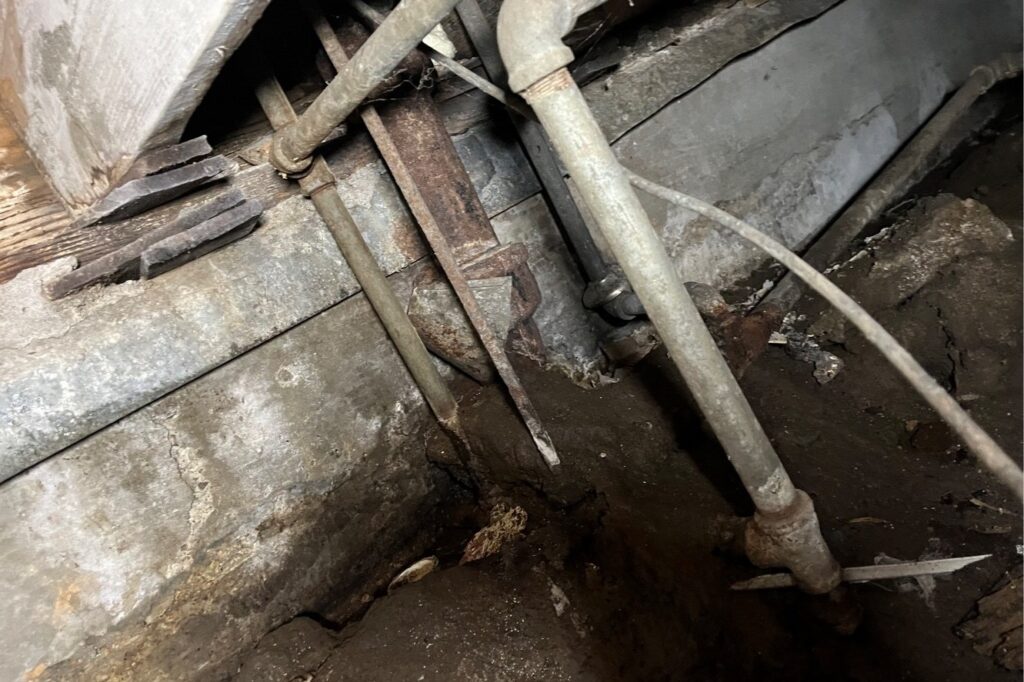
Galvanized steel can easily last 60 to 70 years, and a lot of Tulsa’s older neighborhoods are past that now. If your house still has it, here’s why it fails, how to tell when yours is going, and what galvanized pipe replacement involves, answered the way we’d answer it standing in your utility room.
Why galvanized pipe fails
What actually goes wrong inside the pipe?
Galvanized pipe is steel pipe with a zinc coating. Over decades, the water wears that coating away from the inside, and the bare steel starts to rust. The rust builds up as scale along the inside of the pipe, so a line that started at three-quarter inch slowly closes down. Every fixture runs weaker, and cleaning aerators won’t fix it, because the restriction is inside the pipe itself.
Does Tulsa’s water make it worse?
It doesn’t help. The City of Tulsa reports average hardness of 5.2 grains per gallon from its Mohawk plant and 8.2 from its A.B. Jewell plant, and that mineral content adds scale on top of the rust. Around Tulsa, corrosion is the leak cause we see most, between our hard water and older neighborhoods still on their original galvanized.
How long does galvanized pipe last?
Galvanized steel can easily last 60 to 70 years. Age alone doesn’t mean yours is failing today, but age plus symptoms is the time to plan a replacement instead of waiting for the next leak to decide for you.
How to tell your galvanized is going
What are the signs?
Leaks, flakes in your water, or low pressure. If you’re seeing those, it’s time to repipe. One tell is a hot side noticeably weaker than the cold, because the hot lines scale up first.
Is there a simple test I can do myself?
Let a cold-water faucet sit unused for a few hours, then run the cold into a clear glass. Brown or orange water that shows up again and again, at more than one faucet, points to the pipes. If the rusty water only comes from the hot tap, look at the water heater first.
Can you replace just the bad section?
Sometimes. One leak is a repair. Leaks in different parts of the house inside the same year is a repipe. In between, it comes down to the material, the age, and how close together the leaks came. We’ll tell you which one you’re looking at, even when it’s the cheaper one. For the full list of warning signs, see when to repipe a house.
Replacing it
What do you replace galvanized with?
PEX or copper. PEX is our default because it bends, so we pull it through the attic and down the walls with far fewer holes cut than copper takes. Copper costs more, and it’s the material that pinholes when the water chemistry is against it. We’ll run copper if you want it.
What does the job look like?
A whole-home repipe is typically 1 to 3 days, and you can stay in the house. The water is off while we work, but we turn it back on before we leave every evening. On a slab house, we either open the concrete where we need to or run the new lines overhead through the attic and down the walls.
We cut the access we need, keep the cuts small, and set an access panel where a valve needs to stay reachable, and we haul off the old pipe. Putting the walls back is drywall and paint work, which isn’t our trade, so plan for that separately.
Who handles the permit?
We do. We pull the plumbing permit ourselves under our Oklahoma license (#180753) and call in the inspections on it, so that isn’t something you have to chase.
Is replacing galvanized worth it?
Most definitely. It rids you of those pesky leaks, and it raises your property value when it comes time to sell. It’s also one of the few plumbing jobs you only do once. It’s not fun, but it is rewarding.
What does galvanized pipe replacement cost?
Repiping an entire house ranges from $5,000 to $7,000 on average, with high-end estimates at $15,000 or more for large, difficult homes. Our home repipe cost guide covers what moves it up or down. Don’t count on insurance: a whole home repipe is almost never covered.
Getting yours looked at
Call Tulsa Plumbing & Remodeling at (918) 800-4426. We’ll test the lines, tell you what we find, and give you a written price before anything starts. Our labor carries a one-year warranty, and if a repair will do, we’ll tell you that too.