
How do I know if my gas line is safe? You can’t tell by looking at it, and neither can we. What you can know is the warning signs, what to do the moment you notice one, and how a gas line actually gets checked. This post covers all three, starting with the one that can’t wait.
If You Smell Gas Right Now
Get everyone out, pets included, and leave the door open behind you. On your way out, don’t flip a light switch on or off, don’t unplug anything, don’t hit the garage door opener, don’t light a match, and don’t use your phone until you’re outside and away from the house. Don’t go looking for the leak.
Once you’re outside and away from the house, call 911 and Oklahoma Natural Gas at 800-458-4251. ONG’s own instruction to its customers is to leave the area first and call second, and that’s the right order. If the smell is strong or you hear gas blowing, don’t wait to think it over. Leave first and sort it out from the yard.
The utility owns the emergency and the meter. We own the piping and the appliances on your side of it. Once ONG has the gas off, call us at (918) 800-4426, and we’ll find the leak, repair it, test it, and get you back on.
Warning Signs of a Gas Leak
Natural gas has no smell of its own, so the utility adds mercaptan to it. That’s the rotten egg or sulfur smell most people describe. Not everybody’s nose picks it up, though, and a leak outdoors can blow away before you ever notice it. These are the other signs worth knowing.
A hiss or a whistle
Listen for a hissing or whistling sound near a gas line or an appliance. Gas you can hear blowing gets the same answer as a strong smell, so leave first and call from outside.
Trouble at the appliances
Pilot lights that won’t stay lit, a burner flame that’s yellow or orange instead of blue, and soot or scorching around an appliance are all signs worth a call.
A gas bill that doesn’t add up
A gas bill that climbed with no change in how you live is another one. If nothing new went in and nothing changed about how you use what you have, a higher bill is worth a call.
Dead grass over the line
Look for a patch of dead or dying grass in an otherwise green yard, right where the gas line runs. Gas lines run underground to more places than people think, like a shop, a pool heater, or a grill. Past the meter, those lines are yours to maintain, not the gas company’s.
If you’re not sure, err on the side of leaving and calling. Nobody has ever regretted that one.
When It Isn’t a Leak
Not every gas problem is a leak. Gas piping is sized for a total load, not one appliance at a time, so the pipe has to carry every appliance running at once over the real distance from the meter. Hang a big tankless water heater or a standby generator off a system that was sized decades ago for a furnace, a water heater, and a range, and you can starve everything on the line.
The symptoms are sneaky, and they don’t look like a gas problem. A furnace that short cycles, a tankless unit throwing a low gas pressure code, burners that never come up to a full blue flame, a water heater that can’t keep up in January. An undersized line only shows itself while the appliance is firing, so that’s when we check the gas pressure.
What We Find on Older Gas Lines
Most of what turns up isn’t dramatic. The usual items are a leak at a fitting, a flex connector run through a wall or a cabinet, a missing sediment trap, an unbonded CSST run, or an old capped line left behind from an appliance that’s been gone for years. Most of it is straightforward to correct.
Flex connectors
Appliance connectors are made to be installed once. The flare fittings on the ends seal by deforming metal against metal, and reusing one is a well known way to end up with a slow leak behind an appliance nobody moves for ten years. They also have a rated length, and they aren’t allowed to pass through a wall, a floor, or a cabinet partition. When we set an appliance, it gets a new connector sized for it, a shutoff where it belongs, and a leak check before we leave.
Sediment traps
A sediment trap, also called a drip leg, is a short capped stub of pipe hanging below the gas connection at an appliance. Rust, scale, pipe dope, and moisture traveling down the line drop into it instead of going into the appliance’s gas valve. Code calls for one at every fixture, and it’s an easy thing to leave off when a unit goes in fast. If yours is missing and we’re already working on that line, we put one in.
CSST bonding
CSST is the flexible stainless tubing in a yellow or black jacket. It has to be bonded to the electrical grounding system per the manufacturer’s instructions, because a nearby lightning strike can arc to unbonded tubing and put a pinhole in it. Oklahoma is not short on lightning, so that bond is not a formality. If yours isn’t bonded, we’ll show you and lay out your options, but the bond itself is electrical work, so you’ll want a licensed electrician to make it.
How a Gas Line Gets Checked
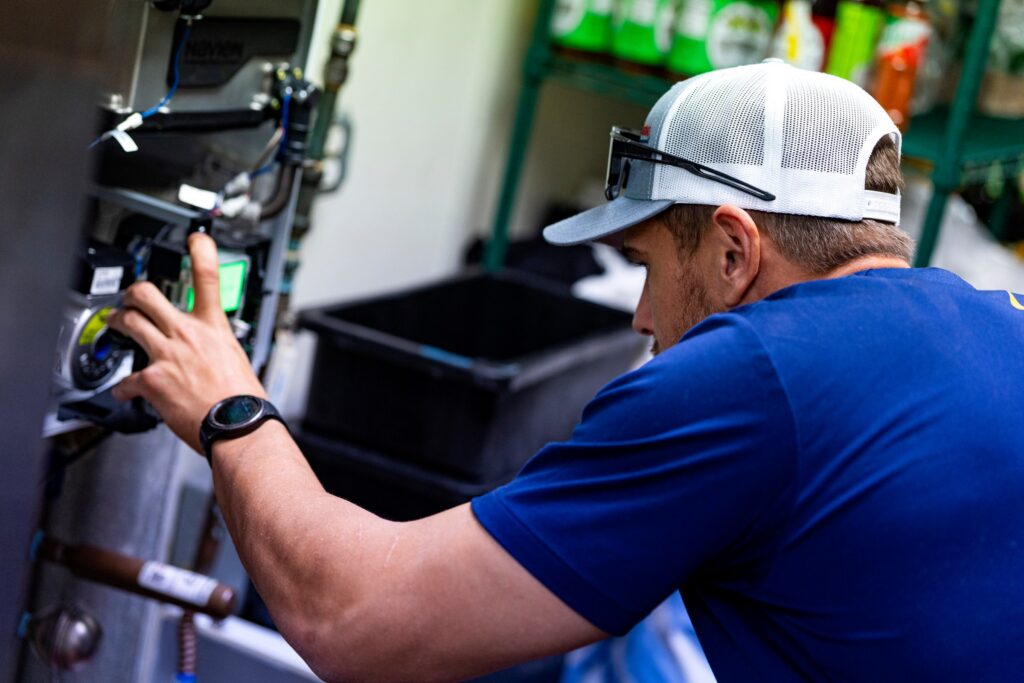
Looking only gets you so far. The way to know the piping itself is tight is a pressure test. We shut the gas off at the meter, disconnect the piping from the meter and every appliance, cap the openings, pressurize the system with air, and put a gauge on it. If the needle doesn’t move, the piping is tight. If it falls, there’s a leak, and we track it down with a combustible gas detector and leak detection solution on the fitting, so you can watch it bubble. Our post on gas line pressure testing walks through the whole test.
ONG’s customer newsletter says the piping on your side of the meter should be checked periodically for leaks and corrosion, and that the inspection and any repairs should be done by a licensed contractor, such as a qualified plumber. Our post on gas piping in Tulsa covers where ONG’s side ends and yours begins.
Don’t Go Looking for It Yourself
We never want you doing gas yourself. Never guess on gas, and never modify a gas line yourself. If something on this list sounds familiar, leave if you smell gas, call ONG, and then call us.
In Oklahoma, gas piping falls under the plumbing license, so there’s no separate gas card to go looking for. Ours is #180753, and we never sub out gas work. Anyone can print a magnet for a truck door, so if you ever want to check a license, ours or anyone else’s, the state keeps a public lookup through the Oklahoma Department of Labor. We’d rather you verify it than wonder about it.
Want Your Gas Line Checked?
Call Tulsa Plumbing & Remodeling at (918) 800-4426. Tell us what you noticed and what’s on the line, like a furnace, a water heater, or a range. If you smell gas, leave and call ONG at 800-458-4251 first. Our general plumbing page covers the rest of what we do.