
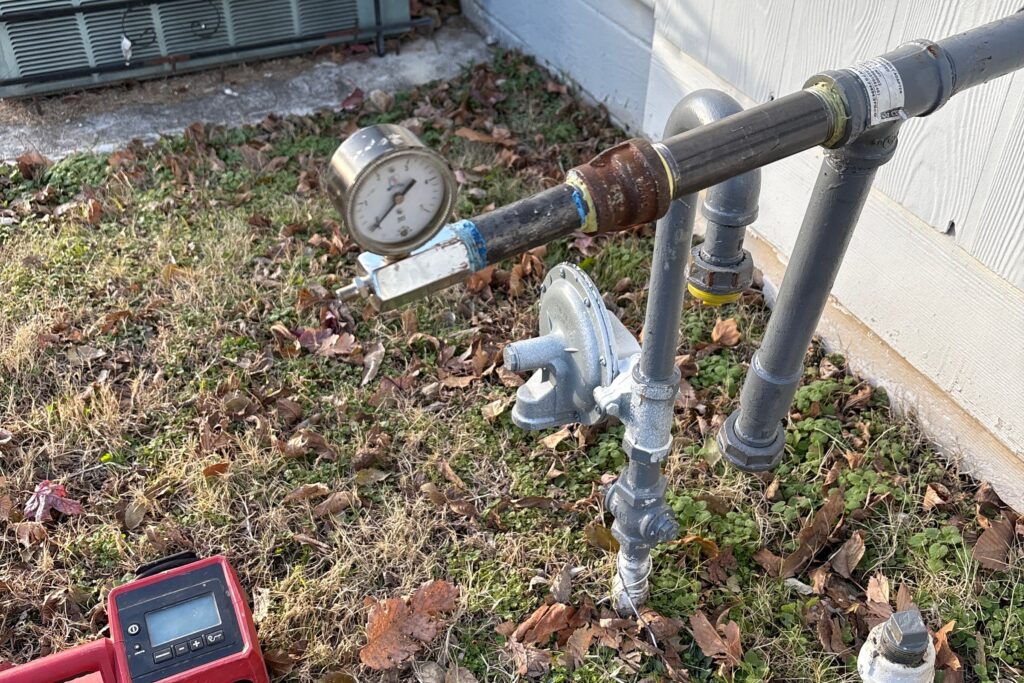
A gas line pressure test answers one question: is the gas piping tight? It’s how a new line or a repair gets proven before the gas goes back on, and it’s what the inspection is passed on. This post covers when you need one, how the test goes, what happens when the needle drops, and how it fits into getting your gas back on after the gas company has locked your meter.
When You Need a Pressure Test
New gas piping, extending or moving an existing line, and most gas repairs need a permit and an inspection here. We’re registered in Tulsa County, Rogers County, and the cities across the Tulsa metro, so we pull the permit under our own license, meet the inspector on site, and run the pressure test in front of them. These are the times it comes up most.
A new gas line
Any gas we run gets tested before it goes into service, whether it’s a line for a range, a dryer, a generator, or a tankless water heater. On new construction, the test happens at rough-in, before anything gets covered.
After a leak repair
However we find a leak, the pressure test is the last step, every time. It’s what the inspection is passed on, and it’s the only thing that proves the repair held.
Before you close on a house
When a home inspection flags a gas issue, call early, because there’s a closing date on it. The usual items on a report are a leak at a fitting, a flex connector run through a wall or a cabinet, or an old capped line left behind from an appliance that’s been gone for years. We can pressure test the whole system, so everybody finds out whether the report caught one loose fitting or whether there’s a real problem in the piping. Ask us for the result in writing and you’ll have it.
How the Test Goes
We shut the gas off at the meter, disconnect the piping from the meter and from every appliance, and cap all the openings. Then we pressurize the system with air, put a gauge on it, and let it sit. If the needle doesn’t move, the piping is tight. If it falls, there’s a leak.
The required pressure and how long it has to hold are set by code and by the local inspector, and they vary by jurisdiction. We confirm what your inspector wants before we test instead of testing twice. On permitted work, the inspector is standing there watching the gauge with us, which is exactly the point.
Plan on the gas being off for a while. If your water heater and furnace are on that system, that means no hot water and no heat until we’re finished and everything is relit and checked.
When the Needle Drops
A falling needle tells us there’s a leak. It doesn’t tell us where. With the appliances disconnected, the test also settles whether the piping itself is leaking or whether the problem is at an appliance connection or a bad valve.
From there, we sweep the runs, joints, valves, and appliance connections with a combustible gas detector, and anything it flags gets confirmed with leak detection solution on the fitting, so you can watch it bubble.
When the leak is somewhere nobody can see, like a line under a slab or a buried run out to a shop or a pool heater, we break the system into sections and test them one at a time until the bad section is the only thing left. Isolating takes longer than guessing. It’s also the difference between opening the right piece of concrete and the wrong one. Once the repair is made, the test runs again, and the needle has to hold.
Getting Your Gas Back On After a Shutoff
If you smell gas, get everybody out first, then call Oklahoma Natural Gas at 800-458-4251. When ONG finds a leak, they shut the meter off, lock it, and leave a tag telling you why. They won’t unlock it because you tell them it’s fixed.
Getting back on takes three steps by three different people. First, we test the system, find every problem on your side of the meter, and make the repairs. Then, if the work required a permit, the city inspector comes out, watches the pressure test, and signs it off. Then the gas company comes back, pulls the lock, turns the meter on, and relights and checks your appliances.
What trips people up is that those are separate visits on separate schedules, so the sooner you start, the sooner you have heat and hot water. If you’re locked out during a freeze, tell us that when you call, because we move those up the schedule.
Why It Isn’t a DIY Job
We never want you doing gas yourself. Never guess on gas, and never modify a gas line yourself. In Oklahoma, gas piping falls under the plumbing license, and ours is #180753. Gas permits are pulled in our name, the inspector meets us on site, and we never sub out gas work. The people running your test work for us.
What a Pressure Test Costs
We provide pricing before we start work so there aren’t any surprises. On leak work, we’ll tell you what the diagnostic and the pressure test run before we do them, and if the repair opens up into something bigger once we’re into it, we stop and talk to you before we keep going.
Need a Gas Line Tested?
Whether it’s a new line, a repair, a home sale, or a locked meter, call Tulsa Plumbing & Remodeling at (918) 800-4426. Tell us whether the gas company has been out and what’s on the line, like a furnace, a water heater, or a range. Our post on gas piping in Tulsa covers where ONG’s side ends and yours begins, and our general plumbing page covers the rest of what we do.