
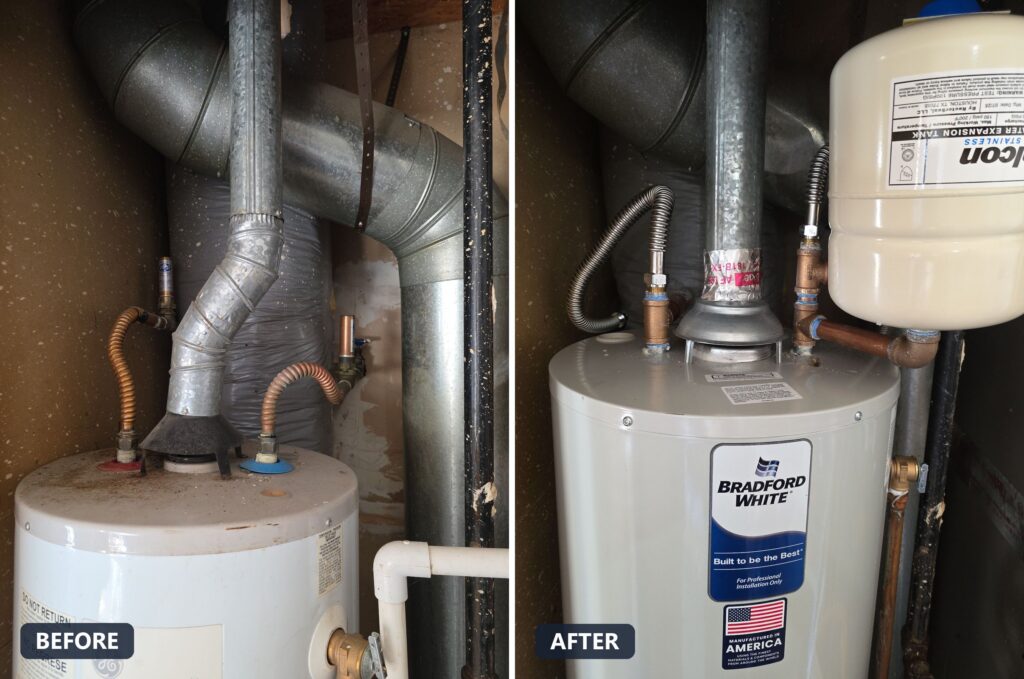
If you’re planning a water heater upgrade in Tulsa, you’re working against two things: age and hard water. The City of Tulsa reports average hardness of 89 mg/L for water from its Mohawk plant and 140 mg/L from its A.B. Jewell plant. That’s enough to leave scale in a tank year after year and wear down the anode rod that protects it. When the rumbling starts or the hot water turns inconsistent, the question usually isn’t whether to act. It’s which system fits your home.
Choosing a water heater replacement in Tulsa isn’t as simple as picking the first unit at the supply house. System type, your existing gas line and venting setup, available utility rebates, and local permit requirements all shape the right answer. At Tulsa Plumbing & Remodeling, our team fields these calls every day. We walk homeowners through this decision before a single wrench turns. This article covers everything you need to make a confident, informed choice about your water heater upgrade.
When your current water heater has run its course
Not every failing water heater announces itself dramatically. Many just get worse slowly. Knowing the warning signs helps you decide whether a repair buys you real time or just delays the inevitable.
Hard water wears a tank out faster, and the warning signs are usually clear: rusty or discolored hot water, rumbling or popping during heating cycles, hot water that runs out sooner than it used to, visible corrosion on the tank, or water pooling around the base. Once a tank is past 12 years old, our standard practice is to recommend replacement, even when a repair would technically work. A water heater repair runs $450 to $900 on our published price list, and putting that money into a tank near the end of its life rarely makes financial sense.
It also helps to understand what “upgrade” means in practice. A like-for-like replacement swaps your old unit for the same fuel type and roughly the same tank size with a modern, better-insulated model. That’s the straightforward path. A true system upgrade means switching to tankless, heat-pump, or a significantly higher-efficiency configuration. Both are valid, but they involve very different conversations, costs, and infrastructure considerations.
Water heater upgrade options in Tulsa: the three main systems
Each system type has a real home in Tulsa. The right fit depends on your existing setup, how you use hot water, and what you’re willing to maintain.
High-efficiency tank models: the straightforward path
A high-efficiency storage tank, whether gas or electric, is the least disruptive upgrade for most Tulsa homeowners. It fits the same footprint, uses the same fuel type, and in most cases reuses the existing venting. Modern units carry better insulation and improved first-hour ratings compared to the builder-grade models common in older Tulsa homes. This is the right choice for anyone who wants a reliable, code-compliant installation without additional gas line or electrical work. We install Rheem, A.O. Smith, and Bradford White, bought through local supply houses rather than big-box stores.
One standard we hold firmly: every water heater we install gets a brass drain valve. The plastic drain valves many manufacturers ship are usually the first part to fail, and we won’t cut that corner on any unit.
Tankless water heaters: what they deliver and what they require
Tankless systems heat water on demand, eliminating standby heat loss and delivering hot water without a tank to deplete. For households with consistent high-volume demand, the appeal is real. That said, many Tulsa homes aren’t set up for a straightforward tankless conversion. The existing gas line often needs to be upsized, commonly from a half-inch branch to three-quarter inch or larger, depending on BTU demand and total connected load. Condensing tankless units also require dedicated sealed venting, which typically means a new exterior-wall penetration because the old atmospheric B-vent can’t be reused. Most units need a nearby grounded receptacle or dedicated circuit as well.
Because those variables swing the installed cost, we don’t publish a flat tankless installation price. For a sense of scale, our recent tankless installs have run about $3,500 to $4,700. The quote you receive from us reflects your actual home, not a national average. We assess the gas line capacity, venting configuration, and electrical setup before recommending anything.
Heat-pump (hybrid) systems: efficiency with conditions attached
Heat-pump water heaters pull warmth from surrounding air rather than generating heat directly, which makes them highly efficient under the right conditions. The important qualifier for Tulsa homeowners is space and temperature. These units require adequate surrounding air volume, commonly 700 to 1,000 cubic feet or more, and they perform best when ambient temperatures stay in the 50 to 90 degree range. In an unheated garage during a Tulsa winter, performance drops as temperatures fall toward the 40s, and the unit’s electric resistance backup activates more frequently. When that happens, efficiency approaches that of a conventional electric heater and the energy savings largely disappear.
A conditioned basement, interior utility room, or an attached garage that stays relatively warm is a much better fit. PSO’s water heater rebate applies to heat-pump units, which we cover below. If the location and rebate align, these units can offer compelling long-term economics despite the higher upfront cost.
How Tulsa’s hard water shapes your decision
Water quality isn’t a footnote in this decision. It’s a core variable that affects operating costs, maintenance frequency, and realistic lifespan for every system type.
In a storage tank, scale from calcium and magnesium hardness settles on the heating element and tank bottom. It acts as an insulator, forcing the unit to run longer to deliver the same temperature. That’s where the rumbling and popping sounds come from: scale-covered elements working harder than they should. In a tankless system, the same minerals restrict the heat exchanger, a far thinner and more sensitive component. Even modest scale buildup in a tankless unit drives up energy use and shortens service life more acutely than it does in a tank.
For a conventional tank in Tulsa, a yearly flush is the baseline. Our flush and tune-up runs $250 to $500 on our published price list: we flush out the sediment, inspect the anode rod, and test the temperature-and-pressure relief valve. If the anode rod is worn, replacing it runs $275 to $525, far less than replacing a tank that has corroded from the inside. For tankless systems, annual descaling is not optional in Tulsa; ours runs $425 to $850 depending on the unit. Hard water alone isn’t a reason to rule out any system, but it does change the maintenance commitment and the real cost of owning each one.
Water heater upgrade cost in Tulsa: what to expect
We use our own published pricing, not national cost-guide averages that don’t reflect Tulsa labor and material conditions. Each range below covers the new heater, labor, removal of the old unit, and standard connections. Anything a job needs that isn’t listed, such as a code correction, is quoted before we do it:
- 50-gallon gas replacement: $1,100 to $2,075
- 40-gallon electric replacement: $975 to $1,850
- 30-gallon electric replacement: $850 to $1,600
- Expansion tank, when your system needs one: $350 to $675
- Water heater repair: $450 to $900
- Tankless descaling: $425 to $850
- Flush and tune-up: $250 to $500
Every installation we complete carries our one-year labor warranty, and the heater itself carries the manufacturer’s warranty, which varies by brand and model. For tankless installation, the cost depends on your home’s gas line capacity, existing venting, electrical supply, and condensate drainage. We assess those factors before quoting, so the number reflects your actual job.
2026 rebates, permits, and what inspectors verify
The incentive landscape shifted in 2026. The federal 25C energy-efficient home improvement tax credit applied to equipment placed in service through December 31, 2025. Installations completed in 2026 do not qualify for that federal credit.
Utility programs are still active, and for some homeowners they’re meaningful. As of October 2026, PSO (Public Service Company of Oklahoma) advertises a $500 rebate for a qualifying ENERGY STAR heat-pump water heater. ONG (Oklahoma Natural Gas) lists four rebates for qualifying gas water heaters:
- $325 for a gas tankless water heater with a UEF of 0.80 or higher
- $650 for a new condensing gas tank water heater with a UEF of 0.80 or higher
- $1,050 for replacing an electric water heater with a new gas water heater
- $1,375 for replacing an electric water heater with a qualifying gas tankless unit
ONG pays rebates first-come, first-served while program funds last, and the application is due within 180 days of installation. Rebate amounts and approved model lists change, so confirm your utility’s current program on its own rebate page before you buy based on a rebate.
On permits: the City of Tulsa requires a plumbing permit to replace a water heater, and we pull the permit. Inspectors verify the temperature-and-pressure relief valve and discharge pipe, thermal expansion control (an expansion tank is required on closed systems), gas shutoff and venting on gas units, and circuit compliance on electric units. Gas line or venting changes bring additional inspection requirements.
What working with Tulsa Plumbing & Remodeling looks like
We assess your home before recommending a system. That means checking the existing gas line capacity, venting configuration, electrical setup, and available installation space. The recommendation fits your home’s actual conditions, not a sales script. We don’t install customer-supplied water heaters. On the rare exception, we note it on the estimate in writing, and that installation carries no warranty. We buy our heaters through local supply houses, so if one fails under warranty, we can carry it in and talk to a person.
You’ll have the price before work starts. No pricing games. We’re licensed and insured under Oklahoma license #180753, and we offer same-day service when the schedule allows.
Making the right call for your home
For most Tulsa homeowners replacing an aging tank, a high-efficiency storage model from a quality brand is the right starting point: familiar infrastructure, straightforward permit process, and no surprises. Tankless systems make sense when the infrastructure supports the conversion and the household demand justifies the added investment. Heat-pump units perform best in conditioned spaces and earn their cost advantage most clearly when a PSO rebate aligns with the qualifying model.
Whichever system you choose, Tulsa’s hard water means maintenance belongs in your cost calculation from day one. Annual flushing and periodic anode rod replacement extend tank life considerably. Annual descaling keeps a tankless unit running efficiently. Skipping those services shortens the life of any system.
Before finalizing your system choice, confirm your utility’s current rebate program directly. The dollar amounts matter, but so do the qualifying model requirements and application timing. Don’t assume a rebate applies until you’ve verified the exact unit on the utility’s approved list.
When you’re ready to move forward with your water heater upgrade in Tulsa, call Tulsa Plumbing & Remodeling at (918) 800-4426. We’ll review your current setup, walk you through the right options for your home, and get your installation on the schedule. A water heater upgrade goes smoothly when a licensed local team handles the permit, the assessment, and the work from start to finish.