
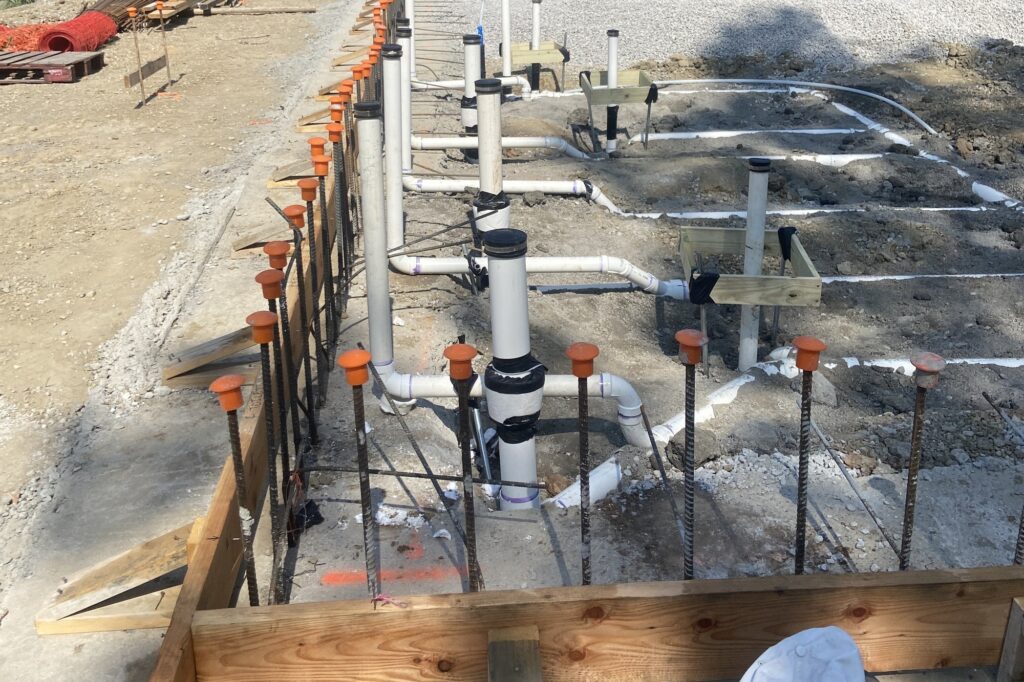
Under slab plumbing is the network of drain lines and water lines buried beneath a concrete foundation before the slab is poured. Once the concrete goes down, those pipes are out of sight and out of reach, and most homeowners never think about them until something goes wrong.
A lot of Tulsa homes are built on slabs, so what’s under yours matters. This article explains what’s down there, how it gets installed, what older Tulsa homes are likely to have, why it fails, and what happens when it does.
What runs under a slab
Two systems share the space under your floor. Drain lines carry waste and water from every toilet, tub, shower, and sink out to the sewer. They work by gravity, so they have to fall toward the sewer the whole way. Water lines carry pressurized water from the main to your fixtures, and because they’re under pressure all day and all night, a leak on a water line never stops running.
When people say slab leak, they usually mean a failed water line. Drain lines under the slab can fail too, and they give different signs. We cover both below.
How under slab plumbing gets installed
Everything under the slab happens once. After the concrete is poured and cured, the only way back to those pipes is through the floor, so the work has to be right the first time.
Laying it out before the trenches
It starts with the floor plan. Every toilet, sink, tub, shower, and floor drain gets marked, and those marks set where the pipes run and where each one comes up through the slab. A stub-up in the wrong spot means cutting concrete later to move it.
Drain lines set at the right fall
Drain lines go in trenches and have to keep a steady fall toward the sewer. Get the grade wrong and waste sits in the pipe instead of moving out. A low spot like that is called a belly, and around here, bellies usually come from Tulsa clay moving with the wet and dry cycles.
Water lines, and why we don’t bury fittings
Water lines are the pressurized side. On the new construction we plumb, we don’t put fittings under the slab. We run a continuous line with no buried joints, because every joint sealed under concrete is one more place a slab leak can start, and one you can’t reach without breaking the floor.
Testing and inspection before the pour
Before any concrete goes over the pipes, the system gets tested and the rough-in gets inspected. A leak found at that stage is an easy fix. The same leak found after the pour means cutting into a finished floor. We pull the permit ourselves, so the inspection is handled.
What’s under older Tulsa slabs
What’s under your floor depends a lot on when the house was built.
Cast iron and clay drain lines
A 1950s house usually has cast iron under the slab and clay out in the yard. Cast iron gives you 50 to 75 years before the bottom channels out, and a lot of midtown Tulsa is sitting in that window now. Houses from the mid 1940s to the early 1970s can also have Orangeburg, a tar paper pipe with a short lifespan.
Copper and galvanized water lines
Older slab homes often have copper water lines under the floor. Copper corrodes from the inside out, so a pinhole says more about the run than the spot. The first pinhole is a repair, and the second in the same house means the whole run. Galvanized steel can easily last 60 to 70 years, and a lot of Tulsa’s older neighborhoods are past that now.
PVC and PEX in newer homes
Newer homes typically have PVC drain lines and PEX water lines. PVC holds up well in the ground, and PEX bends, so it can run in long continuous lengths with far fewer joints.
Why under slab plumbing fails
Tulsa clay
Our clay swells when it’s wet and shrinks when it’s dry, and the ground under a slab moves with it. Over the years, that movement can pull a drain line out of its grade and leave a belly, a low spot where waste sits. You can’t clean a belly out or line it away, because the grade failed, not the pipe. The fix is to re-bed that section at the right fall.
Corrosion
Around Tulsa, corrosion is the leak cause we see most, between our hard water and older neighborhoods still on their original galvanized. On the drain side, cast iron wears from the inside until the bottom of the pipe channels out.
A rushed fitting
Bad installation is a close second, and it shows up years later at a fitting somebody rushed. Under a slab, that fitting is sealed in concrete, which is exactly why we don’t bury them on new work.
Signs something is wrong under your slab
A water line leak shows up as a water bill that jumped or a warm spot on the floor, and your meter keeps moving with everything turned off. A drain line problem is quieter: repeat backups, gurgling, or damp carpet in one spot. Running water you can hear with everything off, a musty smell in a room that never flooded, and new cracks in tile near the floor all belong on the list.
If any of that sounds familiar, check the toilets first with a little food coloring in the tank, then read your meter with everything off. Our slab leak detection page explains what we do next.
How we find and fix problems under a slab
On a water line, we isolate the hot and cold sides and pressure test each one, then pinpoint the leak with acoustic gear that hears water under concrete. On a drain line, a camera shows what’s actually wrong, and a sonde on the camera head marks the spot and depth in paint on your floor.
We don’t tunnel under homes, so we open the concrete from inside and work from above, and only where the problem is. For a water line, the fix is either replacing the failed section or running a new line overhead through the attic. For a drain line, one failed section is a spot repair, while cast iron channeled end to end means replacing the run. Our sewer and slab services and leak repair and repiping pages go into more detail.
We put the concrete back, but tile, wood, carpet, and paint belong to a flooring or general contractor. When the job needs a permit, we pull it, and our labor carries a one-year warranty.
What it costs
The biggest factors are where the problem sits, how much pipe has failed, and what the pipe is made of. A leak under an open garage floor costs far less to reach than one under hardwood in the living room. We find the problem first, then walk you through the options and the cost before any work starts.
If the answer is a whole-home repipe, our own Tulsa job history puts the average at $5,000 to $7,000, with large, difficult homes at $15,000 or more.
The bottom line on under slab plumbing
Under slab plumbing is installed once, buried for decades, and easy to forget until it fails. In Tulsa, the clay, the water, and the age of the pipe all work against it. If you notice a jump in your water bill, a warm spot on the floor, or the sound of running water with everything off, don’t wait. The problem only gets bigger.
Tulsa Plumbing & Remodeling is licensed and insured (Oklahoma plumbing license #180753), with same-day service and no pricing games. Call us at (918) 800-4426 to find out what’s going on under your floor.