
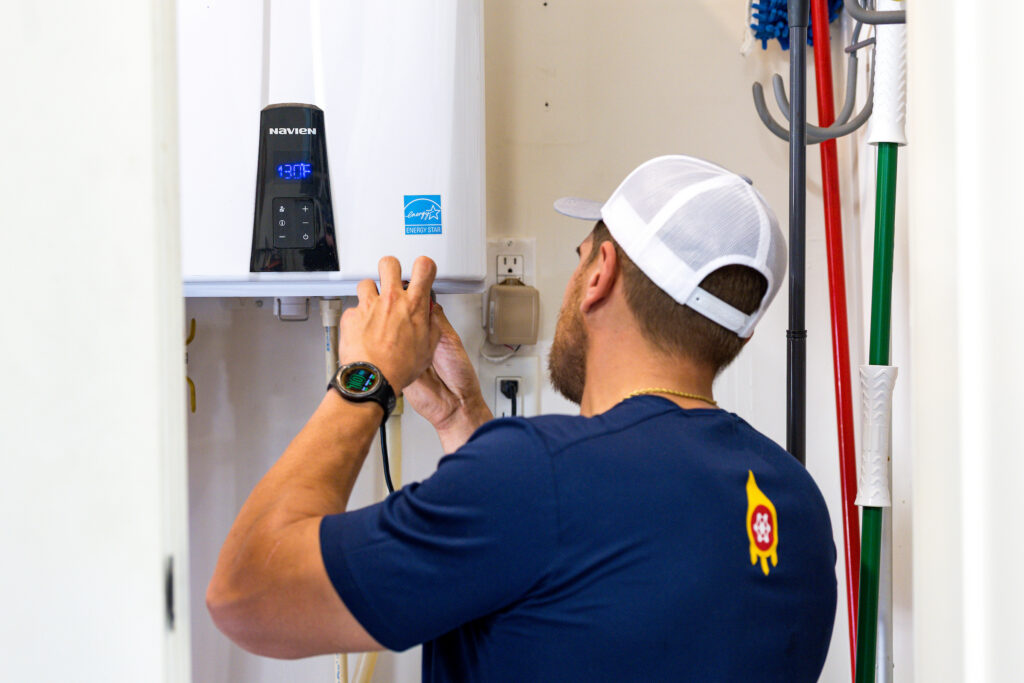
When a water heater finally gives out, a lot of homeowners ask us at Tulsa Plumbing & Remodeling some version of: “Should I just go tankless this time?” It’s a reasonable question, and it deserves a straight answer rather than a sales pitch. Understanding the full tankless water heater pros and cons is the only honest way to answer it. The truth is that tankless water heaters are genuinely better for some households and genuinely worse for others. The right choice hinges on how many people live in your home, what fuel source you have, what your installation actually requires, and what you expect your hot water to do under real daily demand.
This article covers the full picture: energy savings, upfront and installation costs, performance under simultaneous demand, lifespan, and what a retrofit actually involves in an existing home. Neither system wins universally. By the end, you should have enough information to make a confident decision for your specific situation.
How tankless water heaters actually work
A tankless unit, sometimes called an on-demand hot water system, has no storage tank. Cold water enters the unit, a gas burner or electric element fires immediately, and hot water exits within seconds. When you close the tap, the burner shuts off completely. That’s the entire operating cycle. Compare that to a conventional tank heater, which keeps 40 to 50 gallons of water hot around the clock, whether anyone is showering or not.
The standby loss problem that tankless solves
A storage tank loses heat through its walls continuously, every hour of every day. This is called standby loss, and it’s the core reason tankless units use less energy. The tank is always working to maintain temperature even at 2 a.m. on a Tuesday when no one is awake. For households that use modest amounts of hot water, standby loss can represent a surprisingly large share of the total energy bill.
Key specs: flow rate, gas, and electric performance
Flow rate, measured in gallons per minute (GPM), is the number that defines a tankless unit’s real-world performance. The big number on the box assumes a small temperature rise. On a cold January morning in Tulsa, the unit has to heat incoming water much further to reach shower temperature, so it delivers noticeably less hot water than the label suggests. We size for January, not for the box.
Gas tankless units typically reach higher GPM ratings and are better suited for whole-house use, but they require sealed direct-vent piping and adequate gas line capacity. Electric tankless units are simpler to install but draw heavy electrical loads and generally top out at lower flow rates, making them a better fit for point-of-use applications or smaller households.
Tankless water heater pros and cons: the real advantages
There are genuine, well-documented benefits to going tankless. The key is understanding which ones apply to your home rather than to a hypothetical average household.
Energy savings and lower operating costs
The U.S. Department of Energy estimates that a tankless unit is 24 to 34 percent more energy efficient than a storage tank in a home that uses 41 gallons of hot water a day or less, and 8 to 14 percent more efficient in a home that uses a lot of hot water, around 86 gallons a day. What that’s worth in dollars depends on your gas or electric rate and how much hot water you actually use. These are real savings, but they’re not dramatic enough to make the upfront cost irrelevant.
Longer lifespan and space efficiency
Tankless units typically last 15 to 20 years. A standard tank heater averages 8 to 12 years. Past 12 years, we recommend replacing a tank even when a repair would work, since the likelihood of failure rises and failures tend to be messy. A tankless unit wall-mounted in a utility closet also frees up the floor space a 50-gallon tank would occupy. The longer lifespan helps offset the higher upfront cost, but the math still takes years to close. Don’t assume the payback comes fast.
Tankless water heater pros and cons: where a traditional tank still wins
A balanced look at this decision means being honest about where tank heaters continue to win. There are real scenarios where a quality tank replacement is the smarter call.
The upfront cost gap is significant
Our tankless installs in existing Tulsa homes have run about $3,500 to $4,700, depending on venting, gas line capacity, and where the unit goes. A 50-gallon gas tank replacement from our price list runs $1,100 to $2,075. Energy savings close that gap slowly, and the payback on a tankless system can stretch to 10 years or longer, sometimes most of the unit’s usable life. For homeowners on a tighter budget or planning to sell within a few years, the math rarely favors tankless.
Flow rate limits and the cold-water sandwich
Tankless units are sold by their maximum flow rate, and whole-house gas models are commonly advertised in the 8 to 11 GPM range. That rating assumes a mild temperature rise. Two showers running alongside a dishwasher can easily ask for 5 GPM or more of hot water. In winter, when Tulsa’s incoming water can drop toward 40 degrees Fahrenheit, even the largest residential gas units deliver roughly 4 to 5 GPM at the temperature rise needed to reach 120 degrees. If the unit can’t meet demand, the result is reduced flow or lukewarm water, not an error message.
There’s also a phenomenon called the cold-water sandwich. When you turn on a hot tap shortly after a previous use, the residual hot water in the pipes arrives first, then a brief burst of cooler water comes through while the burner spools up, followed by consistent hot water. It’s a minor inconvenience for most people, but it surprises homeowners who weren’t expecting it.
How household size and usage patterns shape the decision
The tradeoffs above don’t apply equally to every home. Mapping them to your actual usage pattern is what turns general information into a useful answer.
Smaller households and light simultaneous demand
For one to two people who rarely run multiple hot-water fixtures at the same time, tankless often works well. Peak demand stays within what a properly sized unit can handle, and the energy savings represent a proportionally larger gain since their hot-water footprint is small. A correctly sized unit, whether electric or gas, won’t struggle with their load. The longer lifespan also means fewer replacements over the years.
Larger families with overlapping demand
A household with three or more people running showers, a dishwasher, and laundry at the same time may need a unit rated at 9 to 11 GPM or more to avoid lukewarm water during peak hours. Units at that capacity carry higher purchase prices, and installed costs climb further with additional venting, gas line sizing, and permits. Some large homes solve this with two linked tankless units, which adds cost and mechanical complexity. For these households, a high-quality 50-gallon gas tank frequently delivers better real-world performance at a fraction of the installation cost. The tank doesn’t care how many fixtures are running simultaneously.
What a tankless retrofit actually involves in an existing home
Many homeowners get a rough estimate for a tankless unit and are caught off guard by the final bill. The gap usually isn’t dishonesty. It’s the infrastructure upgrades that a simple swap-out quote doesn’t account for.
Venting, gas capacity, and electrical demands
A gas tankless unit generally cannot reuse the old tank’s B-vent or chimney flue. It requires sealed direct-vent piping, typically Category III stainless steel or approved PVC, with new penetrations through an exterior wall or roof. Manufacturer specifications and local codes drive these requirements, and exceptions are rare. The burner also demands 140,000 to 200,000 BTU per hour of gas capacity, compared to about 30,000 to 50,000 BTU per hour for most storage tanks. If the existing gas line is undersized for that load, it needs upgrading before the unit can run safely. We run gas piping ourselves, so that work goes on the same estimate.
Electric tankless units carry their own constraints. Whole-house models often require multiple dedicated 240-volt circuits and sometimes trigger a panel upgrade. That’s an electrician’s work and a separate cost, so get it priced before you commit.
Hard water, descaling, and ongoing maintenance costs
Tulsa’s water is hard enough to build mineral scale on a tankless heat exchanger over time, reducing efficiency and eventually causing flow and temperature errors. Annual descaling is the standard maintenance for most Tulsa installations. From our price list, a heat exchanger flush runs $175 to $350, and a full descaling service runs $425 to $850, depending on the unit and how much scale has built up. That’s a real recurring cost that belongs in any honest comparison against a tank, which typically needs only a periodic flush and anode rod check.
It’s also worth noting the difference between condensing and non-condensing tankless models. Non-condensing units vent exhaust at higher temperatures and require heat-resistant venting materials. Condensing units extract additional heat from combustion gases, making them more efficient, but they produce acidic condensate that requires a proper drain, sometimes with a neutralizer installed inline. Condensing models cost more upfront yet tend to deliver better long-term efficiency, particularly in high-use households.
How to decide what’s actually right for your home
At this point, you have the core tankless water heater pros and cons. Translating them into a decision for your specific home comes down to a handful of practical questions.
The questions worth answering before you buy
Work through these before committing to either system:
- How many people live in the home, and how often do hot-water demands overlap during peak hours?
- Is natural gas available, and does the existing gas line have the capacity for a high-BTU burner without an upgrade?
- If electric, can the panel support a whole-house unit, or would a service upgrade be needed?
- What is the realistic installed cost, including venting, gas line work, permits, and any electrical changes, and how does that compare to a quality tank replacement?
- How long do you plan to stay in the home, and does the payback period match that timeline?
Frequently asked questions about tankless water heaters
Are tankless water heaters worth it for a family of four? Often yes, provided peak demand doesn’t consistently exceed what the unit can deliver in winter and the retrofit infrastructure costs are manageable. A gas tankless unit sized for January water temperatures typically handles a four-person household well. Weigh the full installed cost against your realistic energy savings to confirm the payback period fits your plans.
How much does a tankless retrofit cost in Tulsa? Our tankless installs in existing Tulsa homes have run about $3,500 to $4,700, depending on venting path, gas line work, and permits. A new gas line run costs more, and an electrical panel upgrade is a separate electrician’s cost.
Is a tankless unit worth it if I have hard water? It can be, but you need to factor in annual descaling maintenance. Tulsa’s moderately hard water will build scale on a heat exchanger over time. A whole-house water softener or filter system can reduce that burden significantly and extend the unit’s service life.
What a thorough water heater consultation covers
When a homeowner calls us about replacing their water heater, we start by calculating their actual peak hot water demand, not what a manufacturer’s chart says about square footage. We look at the gas line, the available venting path, the incoming water temperature, the electrical panel if electric is on the table, and the household’s real usage patterns before recommending anything. That process is how we avoid putting an undersized tankless unit in a home that needs more during the morning rush, or quoting a tankless installation when a good 50-gallon tank would serve that family better for considerably less.
The right heater is the one sized for your home, not the one with the best marketing. If you want a straight recommendation based on your actual setup, that’s exactly what we provide. One note if you’re shopping online: we don’t install customer-supplied water heaters. Your warranty is only as good as the person who stands behind it, and we want that to be us. Reach our team at (918) 800-4426. We’re licensed and insured under Oklahoma license #180753, and we’ll tell you what makes sense for your home without pressuring you toward the more expensive option.
The bottom line on tankless water heater pros and cons
Tankless water heaters offer genuine energy savings, a longer service life, and reliable hot water when sized correctly for the home. Those are real advantages. But they carry higher upfront and installation costs that can take a decade or more to recover through energy savings alone, and they have flow-rate ceilings that matter during peak demand in larger households. They also require more involved ongoing maintenance, especially given Tulsa’s moderately hard water.
For smaller households with manageable simultaneous demand, the economics and performance often favor going tankless. For larger families with heavy peak loads, or homeowners on a tighter budget, a quality tank replacement frequently wins on cost, simplicity, and real-world performance. The tankless-versus-tank decision doesn’t have a universal answer. It has the right answer for your home.
Need help weighing the tankless water heater pros and cons for your specific situation? Get in touch with us at Tulsa Plumbing & Remodeling. Call (918) 800-4426, and we’ll walk through the options with you.